The Tew Family
Written by Ian and Stephanie Davis. Started 20 March 2026. Last updated 8 September 2026.
Introduction
This account traces five generations of the Tew family, from a labourer’s marriage in a small Buckinghamshire village in 1786 through to a painter and decorator’s household in mid-twentieth-century Northampton. It covers roughly a hundred and seventy years, during which the family moved gradually eastward - from Shalstone, through the farmland of the Buckinghamshire-Northamptonshire border, into the villages around Towcester, and finally into the streets and factories of Northampton itself. The trajectory is one that thousands of English labouring families followed over the same period: from the land to the town, from agriculture to industry, from parish registers to civil records.
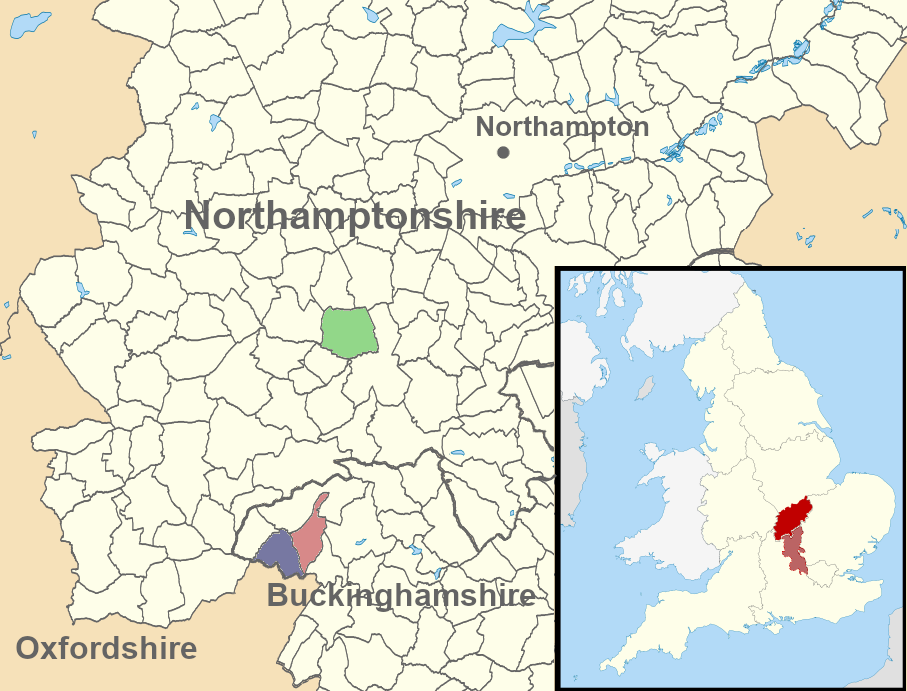
The world in which the story opens was the far north-western corner of Buckinghamshire, a narrow tongue of the county that runs up between Northamptonshire and Oxfordshire and comes within a few miles of Warwickshire. Shalstone, Westbury and Water Stratford, home to the earliest generations, lie in the upper valley of the Great Ouse on the heavy, cold clay that gives the district its character. This was grazing country: across the seventeenth and eighteenth centuries the open arable fields were enclosed and laid down to pasture, and sheep and cattle rather than corn became the mainstay of its farms - which is why the trades that recur in these pages are those of the shepherd and the horsekeeper rather than the ploughman. Enclosure concentrated the land in few hands and left families like the Tews among the landless poor, dependent on wages and on the lace that women and children worked, a cottage industry long established across these border parishes.
The family name itself belongs to this same corner of England. “Tew” is most likely a place-name, taken from the villages of Great, Little and Duns Tew in north Oxfordshire, under twenty miles south-west of Shalstone. The earliest known bearer, a Hugo de Tiw, appears in the Oxfordshire records as early as 1130. What the name meant is uncertain, probably a ridge or row of land, the low rise along which the villages still stand. We can’t take it as proof that our own Tews came from there, since by the eighteenth century surnames had long fixed and detached from their origins, and the spelling in our period was still unsettled, the militia census of 1798 recording the Shalstone family as “Tue”. But the name’s home ground lies in the same Oxfordshire and Northamptonshire border country as the family who carried it.
This narrative is built almost entirely from documentary sources - parish registers of baptisms, marriages, and burials, civil registration records, census returns, and death certificates. These are the records that survive for families who left no letters, diaries, or property deeds. They tell us when people were born, whom they married, what work they did, where they lived, and how they died. They don’t tell us what they thought or felt, and we haven’t tried to invent that. Where the records are silent or ambiguous, we’ve said so. Where we’ve drawn inferences - about parentage, about naming patterns, about the reasons for a move or a gap in the record - we’ve set out the reasoning and flagged the uncertainty. And for the most recent generation, where living memory still reaches, we’ve drawn on a few recollections handed down within the family, marked as such where they appear.
Contents
The account runs as a chapter for each generation, followed by three appendices that give some additional information.
- William Tew and Anne Hinson
- Thomas Tew and Lydia Fetters or Fletcher
- George Tew and Catherine Whitehead
- Annie Louisa Tew and Herbert Goode Rogers
- Bertie Herbert Tew and Beatrice Mabel Rogers
- Appendix I: The Origins of the Tew Family
- Appendix II: The Fetters and Fletcher Names
- Appendix III: DNA Evidence
Names of direct ancestors are written in boldface, other relatives are italicised.
William Tew (c. 1752-1812) and Anne Hinson (1766-1826)
4x great grandparents
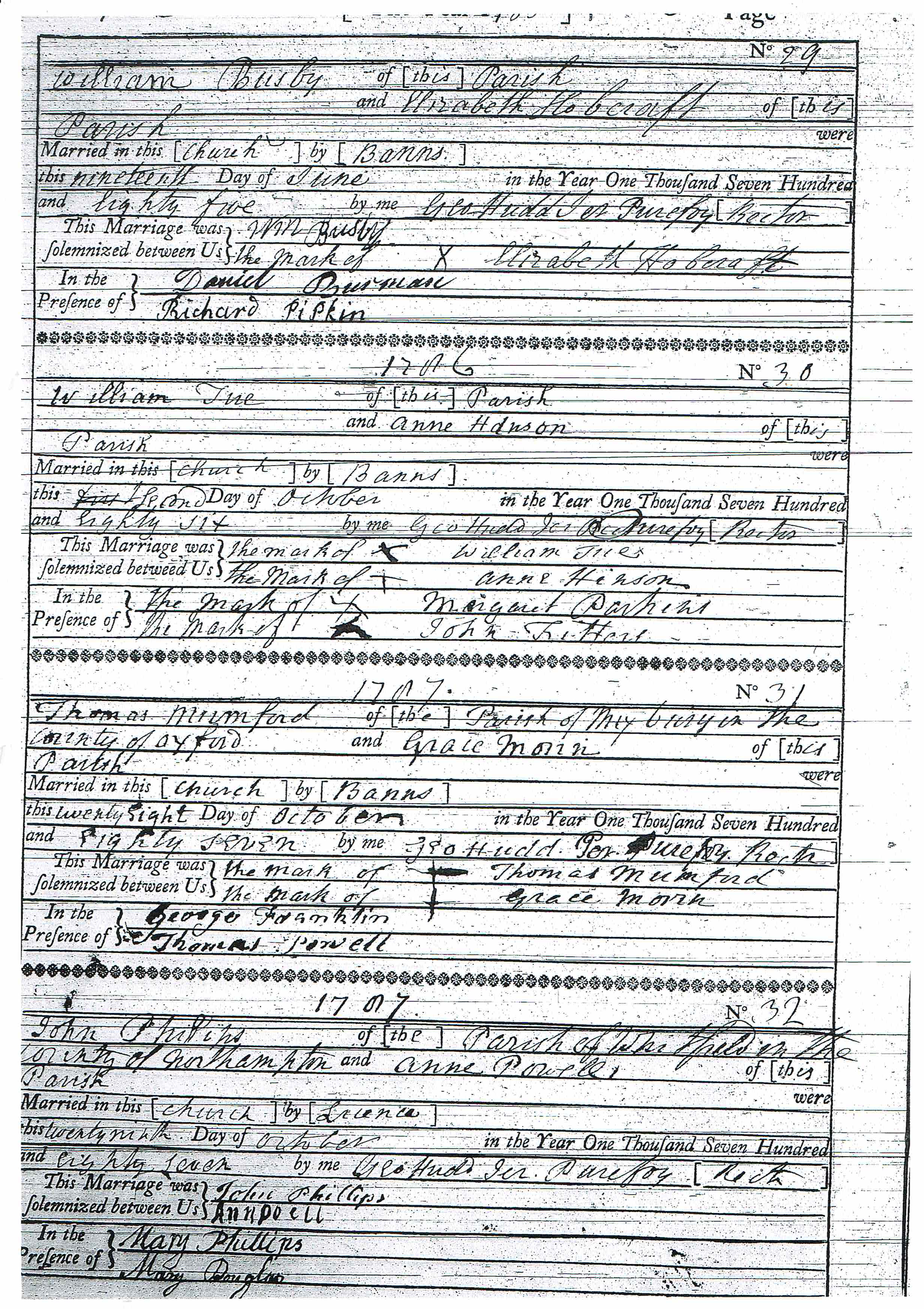
The story of our branch of the Tew family begins, as far as the documentary record allows, with a marriage in the autumn of 1786. On 17th October of that year, William Tew married Anne Hinson at St. Edward’s Church in Shalstone, Buckinghamshireba21. The marriage register describes him as “of this parish,” confirming that he was already settled in Shalstone by that date.
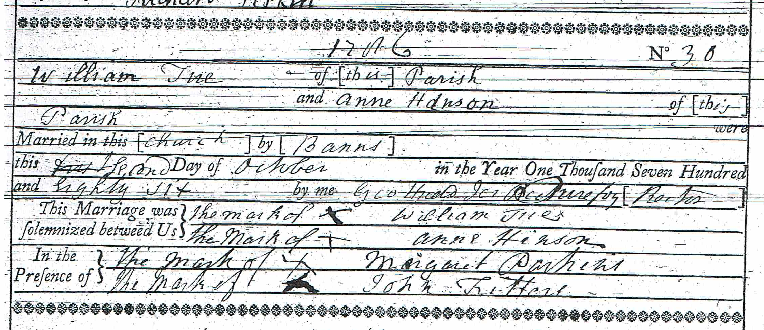
In the register William’s surname is written “Tue”, the spelling the Shalstone clerks generally used for the family. Both witnesses to the marriage signed by mark: Margaret Parkins, and - on the lower line - a name that reads as John Fetters. It’s a name the family met again: William and Anne’s son Thomas would marry a Lydia Fetters nearly forty years later.
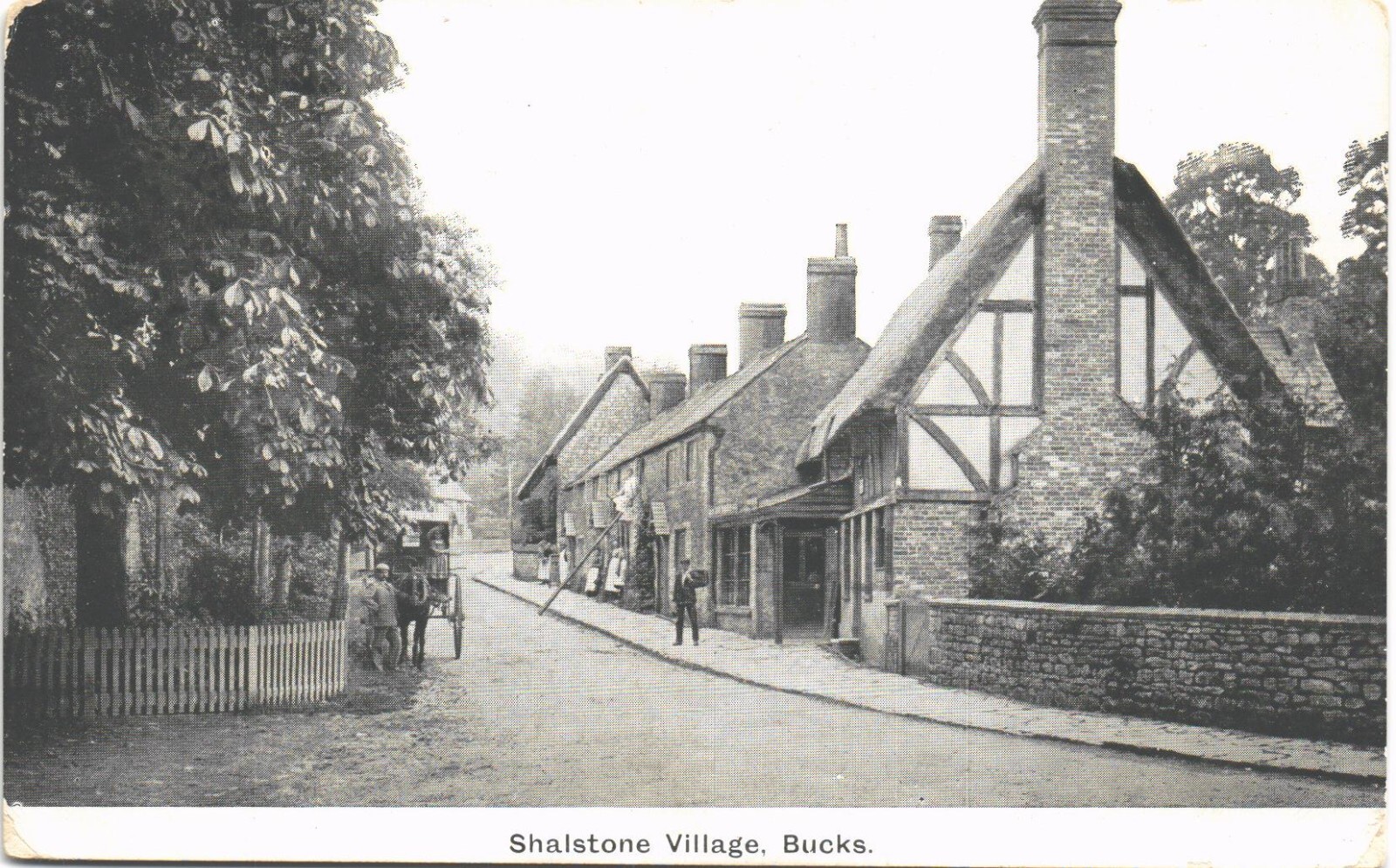
Shalstone, where the couple married and settled, was a tiny parish just four miles north-west of Buckingham. In the late eighteenth century it was home to barely two hundred people, clustered around the manor house of the Purefoy family and the small church of St. Edward the Confessor. The village sat on clay soil, and its economy was almost entirely agricultural. The Purefoy family, who had held the manor for over three hundred years, had died out in the male line in 1762, and in 1768 the estate passed to George Huddleston Purefoy Jervoise, a cousin of the last Purefoy squire. Jervoise held both the manor and the living of the parish, serving as rector of St. Edward’s until his death in 1805 - so the squire who owned Shalstone and the parson who married William and Anne there in 1786 were one and the same man, who signed the marriage register himself as “George Hudd. Purefoy”. It was a quiet, inward-looking community, and the Tews were among its labouring poor.
William’s origins are uncertain. We believe he was born around 1752, probably the son of Corbet Tew and Sarah Allen, but no baptismal record has been found for him, nor any record of Corbet and Sarah’s marriage. What we do know is that Corbet and Sarah were raising a family in Shalstone from the mid-1750s onward: baptism entries survive for their children Corbett (known as Corby, 1755), Mary (1757), Ann (1765), and Thomas (1769), all in the parish. If William was indeed their eldest son, born around 1752, he may have been born wherever Corbet and Sarah were living before they came to Shalstone. The theories about the family’s earlier origins are discussed in Appendix I.
Several strands of circumstantial evidence support the link between William and Corbet. These are the only Tews found in the registers of Shalstone or the surrounding parishes during this period, so the pool of possible parents is small. William’s choice of names for his own children also fits the traditional pattern of honouring grandparents: his first son was Corbet, his first daughter Anne (after his wife’s mother Ann King), his second daughter Sarah, and his second son Thomas. If William was the son of Corbet and Sarah, these names fall neatly into the convention of naming the first son after the father’s father, the first daughter after the mother’s mother, the second daughter after the father’s mother, and the second son after the mother’s father (Thomas Hinson being Anne’s father).
In the last years of the eighteenth century, England was in a heightened state of alert, fearful of a French invasion during the Revolutionary Wars. A census of able-bodied men who could be called to fight was taken in 1798. This document, known as the Posse Comitatus, survives for Buckinghamshire and lists four Tews (spelled “Tue”) in Shalstonebh1: John Tue and Thomas Tue, servants, and Corbey Tue and William Tue, labourers. Corbey is the Corbett baptised in 1755, son of the elder Corbet Tew, who had died in 1794. John was Corbey’s eldest son, about nineteen at the time. William is presumably our William Tew, and Thomas is probably another of the elder Corbet’s sons. Across the whole of Buckinghamshire the Posse names eight men called Tew or Tue, four of them - half - in Shalstone, a measure of how firmly the family had settled in the one parish. The same return carries a single Fetters in the entire county: John Feters of Shalstone, a labourer, very likely the John Fetters who had witnessed William and Anne’s marriage twelve years before. The listing places William alongside the rest of the Tew family as part of the same small Shalstone community.
Despite all this circumstantial evidence, no surviving record actually names Corbet and Sarah as William’s parents. It’s a strong probability, not a certainty.
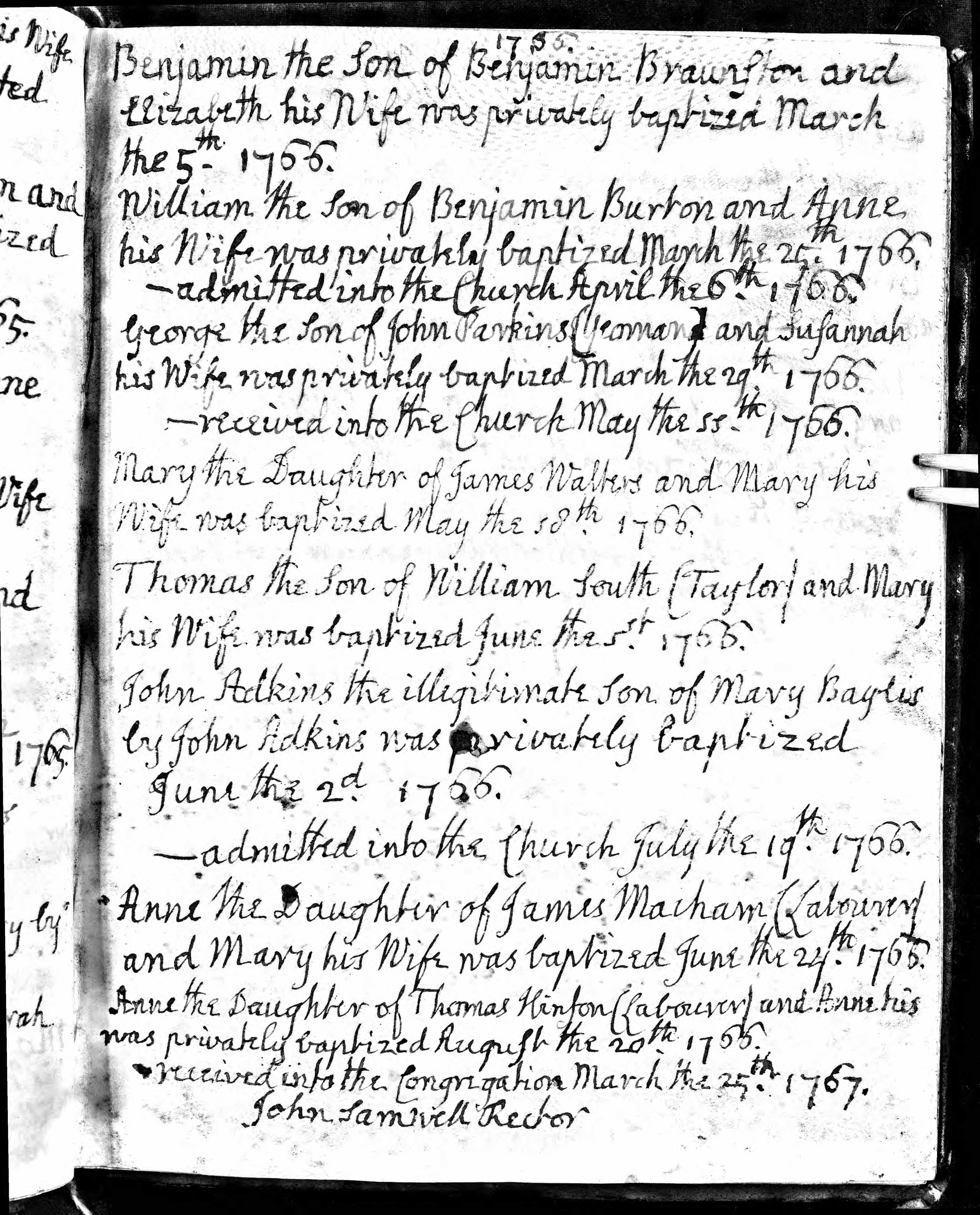
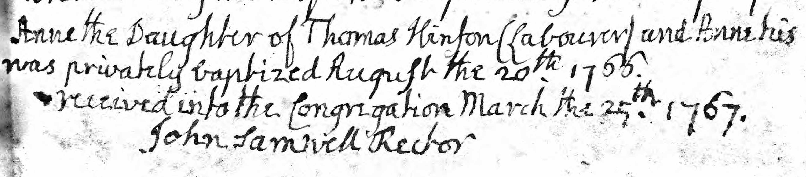
Anne, by contrast, can be traced a little further back. She was baptised on 20th August 1766 in the parish of Helmdon in Northamptonshirebg1, the daughter of Thomas Hinson (1725-1799) and Ann King (1722-1777). Helmdon was a village on the River Tove, about five miles north of Brackley, known at the time for its fine limestone quarries - Helmdon stone had been used in the construction of Blenheim Palace and other great houses earlier in the century - and for its lacemaking, a cottage industry that occupied many of its women and children. Anne’s baptism there places the Hinson family in the rural labouring world of south Northamptonshire.
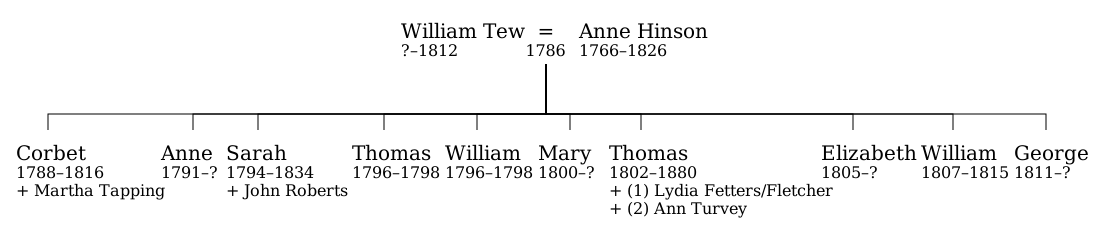
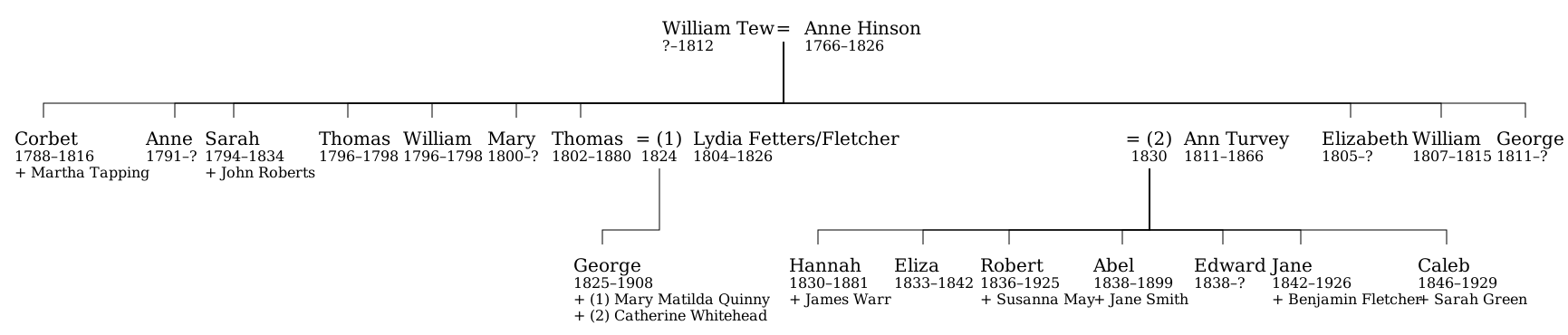
William and Anne had ten children between 1788 and 1811, all baptised at Shalstone. Their first child, Corbet, was baptised on 30th March 1788ba20 and was buried on 30th December 1816 in Shalstoneba19. A daughter, Anne, followed, baptised on 30th September 1791ba18, then Sarah on 7th December 1794ba17.
The year 1796 brought twins: Thomas and William, both baptised on 24th Aprily13y12. Neither survived infancy. Thomas was buried in 1798ba16, and William was buried on 30th October 1798ba15. The loss of two children in the same year was unremarkable in this period. Infant and child mortality among the rural poor of late Georgian England was high, and Shalstone’s parish register records many such short lives.
These were also years of exceptional hardship across the English countryside. War with revolutionary France, declared in 1793, diverted grain to the army and navy and choked off imports, and a run of failed harvests - those of 1795 and 1799 among the worst of the century - sent prices soaring. A quarter of wheat that had cost some 43 shillings in 1792 fetched over a hundred by the summer of 1795, and the loaf that was the labouring family’s staple roughly doubled in price, while farm wages of five or six shillings a week stood still. This was the world William and Anne were raising their children in.
Mary was baptised on 14th January 1800ba14, followed by a second Thomas on 12th December 1802ba7. Elizabeth came on 7th July 1805ba13, then another William - the third of that name in the family - on 27th December 1807ba12. Like the infant twin before him, this William too died young, buried on 29th November 1815 at the age of sevenba11. The last child, George, was baptised on 21st July 1811ba10.
William Tew was buried on 13th August 1812 in Shalstoneba9. His death came in a year that saw Napoleon’s disastrous invasion of Russia and the beginning of the end of the long wars that had shaped the economic landscape of his adult life. Anne outlived him by some fourteen years and was buried on 27th December 1826 also in Shalstoneba8.
Of the ten children, three - Thomas and William (the twins) and the second William - died in childhood. The surviving children grew up in a Buckinghamshire village where the choices for labouring men were the fields and the farmyard, and for women the lace pillow. Of the surviving children, three can be followed a little further. Corbet married Martha Tapping and had two children, but the household was short-lived: Martha died in 1815 and Corbet at the end of 1816, leaving the two children orphaned. His sister Anne married Samuel White of Steeple Claydon in 1813bf1 and settled there with him; they had two children before Anne herself died in 1816be1, aged about twenty-five, and was buried at Steeple Claydon - the same year that took her brother Corbet. Their sister Sarah fared better: she married John Roberts at Syresham, just over the Northamptonshire border, in 1814bd2, and raised a large family there - ten children in all - before her death in 1834, at about forty; she was buried in the parish where she had spent her married lifebd1. The remaining children - Mary (1800), Elizabeth (1805) and George (1811) - each leave a baptism in the Shalstone register and then disappear from the records we have searched, most likely married out of the parish or gone, like others of their generation, in search of work elsewhere.
The second Thomas, baptised in 1802, carries the family line forward.
Thomas Tew (1802-1880) and Lydia Fetters or Fletcher (1804-1826)
3x great grandparents
Thomas Tew was baptised on 12th December 1802ba7, the son of William Tew and Anne Hinson. He grew up in the aftermath of the Napoleonic Wars, a period of agricultural depression and rural unrest across southern England. The end of the wars in 1815 brought a collapse in grain prices, and the Corn Laws, designed to protect English farmers by restricting cheap imports, did little for labourers whose wages fell even as bread remained dear.
Thomas became a shepherd, one of the oldest and most solitary of rural occupations. In the rolling pasture around Shalstone and Westbury, sheep were a significant part of the farming economy, and a skilled shepherd - responsible for lambing, shearing, and the general health of the flock - was a valued member of the agricultural workforce, though still poorly paid.
He married Lydia Fetters or Fletcher on 23rd September 1824 at St. Edward’s Church in Shalstoneba6. Lydia had been baptised on 3rd June 1804 at the same churchba5, the daughter of Benjamin Fetters (1767-1859) and Martha Harrup (1776-1864). The uncertainty over Lydia’s surname wasn’t just clerical inconsistency; the name really was changing, gradually, over more than half a century within the family. Benjamin was born Benjamin Fetters, probably around 1767, and possibly in Shalstone, though no baptismal entry has been found. In the early 1800s he and his family began to appear in parish records under both Fetters and Fletcher, and the transition between the two names was not sudden or consistent. Lydia herself was baptised as Fletcher in 1804 but married as Fetters in 1824 - a sign of how unsettled the change still was, even within the household. The older name wasn’t dropped for good until the 1850s and 1860s; Fetters appears nowhere in the records after 1864. The story of this name change is discussed more fully in Appendix II.
The marriage produced one known son: Steph’s great great grandfather George, baptised on 27th February 1825 at St. Edward’s Church in Shalstoneba1. But the couple’s time together was short. Lydia was buried on 10th November 1826 in Shalstone, at the age of just twenty-twoba4. The records don’t give a cause of death, but the timing - less than two years after George’s birth - makes it possible that her death was connected to childbirth or its aftermath, which remained among the leading causes of death for young women well into the nineteenth century. Thomas was left a widower at twenty-three with an infant son. As a working man he would have sought help from the women in his family to look after young George.
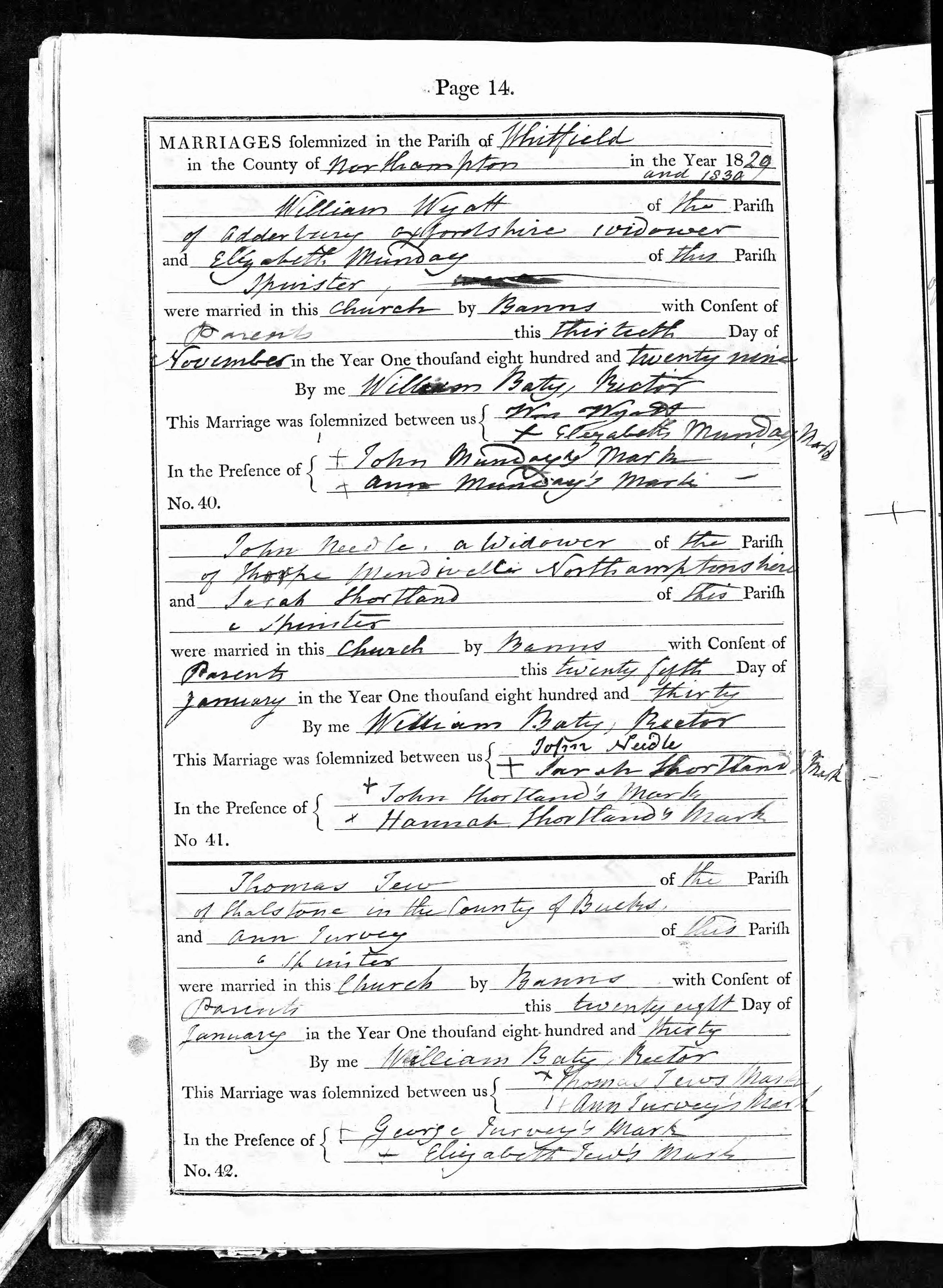
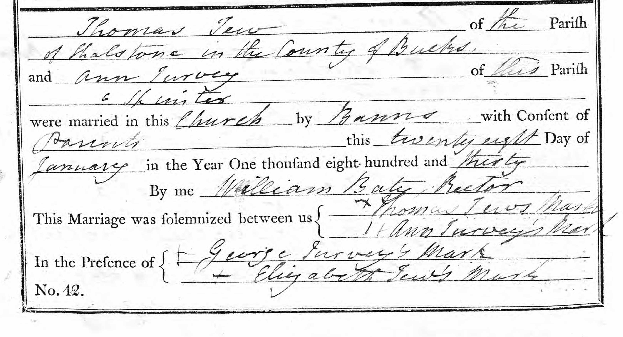
Thomas married again four years later, on 28th January 1830 at St. John’s Church in Whitfield, Northamptonshirebb2, just a few miles from Shalstone. His second wife was Ann Turvey (1811-1866), and the couple made their home at Wood Green, a farm to the north of the village, where they raised a large second family.
Hannah was born there in 1830 and was baptised on the 19th December that yearba3. Eliza, baptised on 22nd September 1833y11, did not survive childhood: she died at the age of eight and was buried on 13th January 1842ba2. Robert followed, baptised on 21st August 1836y10, and Edward on 18th November 1838y9. Edward seems not to have survived infancy: no record of him survives beyond his baptism, and he was already gone by the 1841 census. Abel was born on 7th November 1838b21. Jane was baptised on 12th June 1842y8, and the youngest, Caleb, born on 9th July 1846b20.
The biblical names among the children - Abel, Caleb - hint at a family shaped by the Nonconformist traditions that ran strongly through rural Buckinghamshire and Northamptonshire. Whether Thomas and Ann attended chapel rather than church we can’t say for certain.
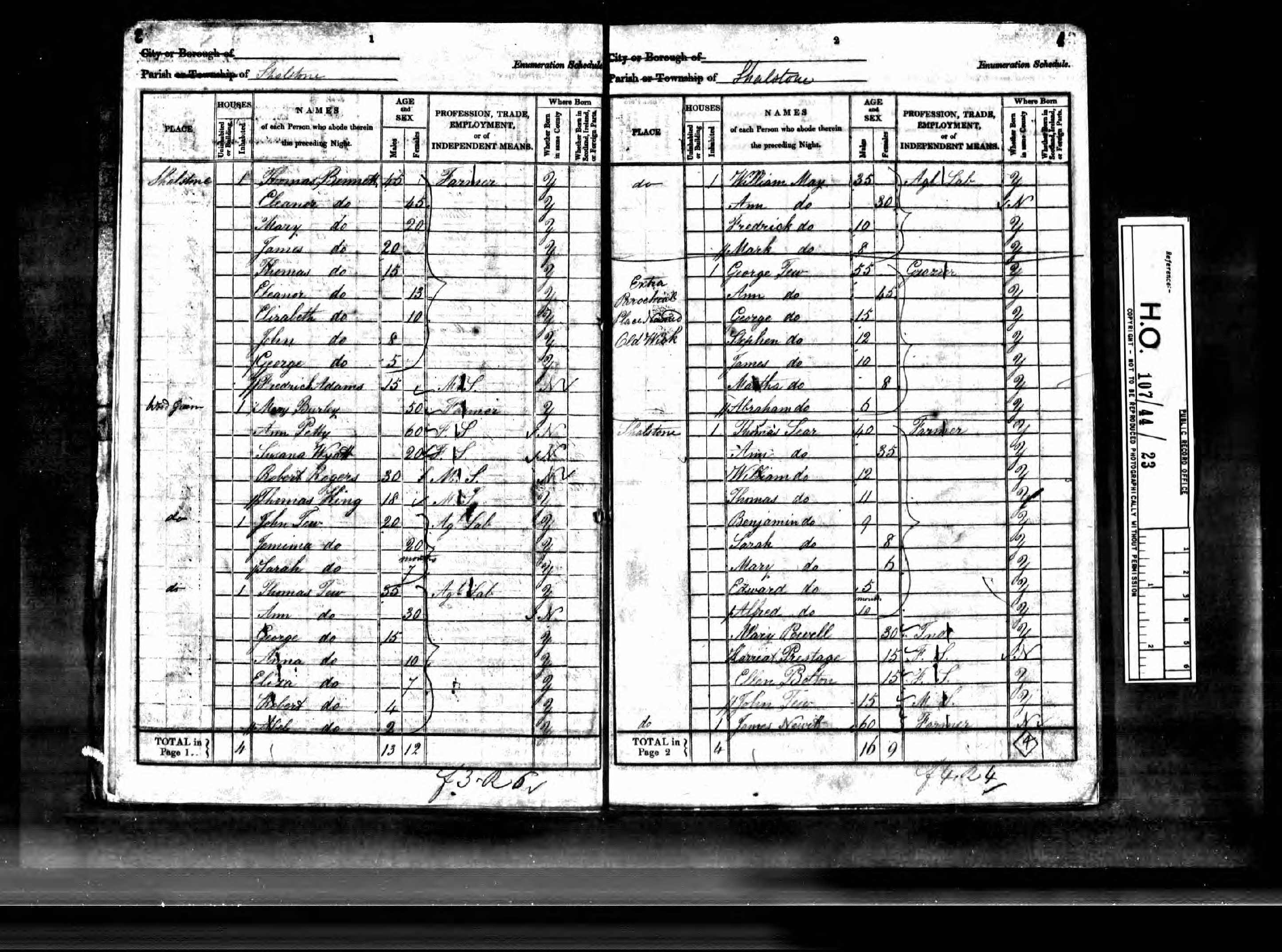
The 1841 census, the first to record households by name, found the family at Wood Green farmbc1. Thomas was there with Ann and five children - George, the son of his first marriage and now sixteen, together with Hannah (entered as Anna), Eliza, Robert and Abel - and was set down as an agricultural labourer, the catch-all the enumerators used for farm workers of every kind, shepherds included. The farm itself was held by Mary Burley, a woman in her early fifties.
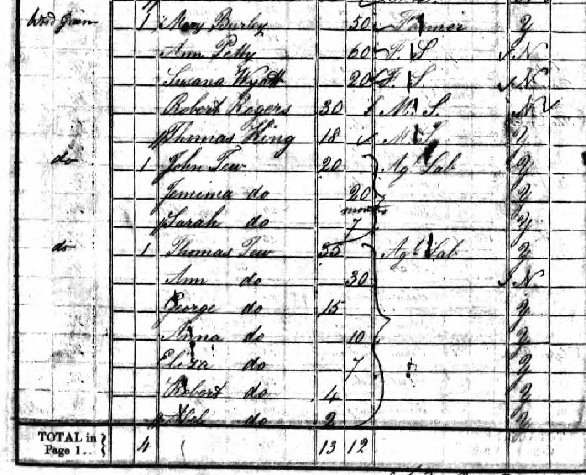
They were not the only Tews at Wood Green. Sharing the farm was the household of John Tew, another agricultural labourer, with his wife Jemima and their infant daughter Sarah. John was the son of Thomas’s cousin George Tew, who was himself the son of Corbey Tew and Joyce Pennill. This elder George Tew, a grazier, appears on the same page of the census at Old Wick, a house close to the farm, where he was living with his wife Ann Keene and five more children. The entries catch the wider Tew family living and working within a few hundred yards of one another on the northern edge of Shalstone - Thomas and his kin labouring on and around the same farm, with the grazier branch settled close by at Old Wick.
A glimpse of these years survives in the local press. In January 1847 the Buckingham petty sessions convicted a “Thomas Tew, of Shalstone” of taking a pheasant at Billesden (almost certainly Biddlesden, a neighbouring parish), fining him £4 with 19 shillings costs and committing him to three months in gaol when he couldn’t pay. We can’t say for certain the man was ours: as we’ve seen, Shalstone held more than one Tew household, and there was at least one other Thomas Tew in the parish at the time, with nothing in the report - no age, no trade - to tell them apart. Our Thomas fits the part well enough, a Shalstone shepherd of forty-five in 1847. Whoever it was, though, the case shows how heavily the Game Laws bore on the rural poor. Game belonged to the landowner, its taking hedged about by a severe body of law and watched, in this country, by the gamekeepers of the Duke of Buckingham, whose Stowe estate spread across the parishes around Shalstone. A fine of £4 - several months of a labourer’s wages - was beyond any hope of payment, so the sentence in practice meant gaol; and the pheasant behind it would have been welcome meat in a shepherd’s cottage.
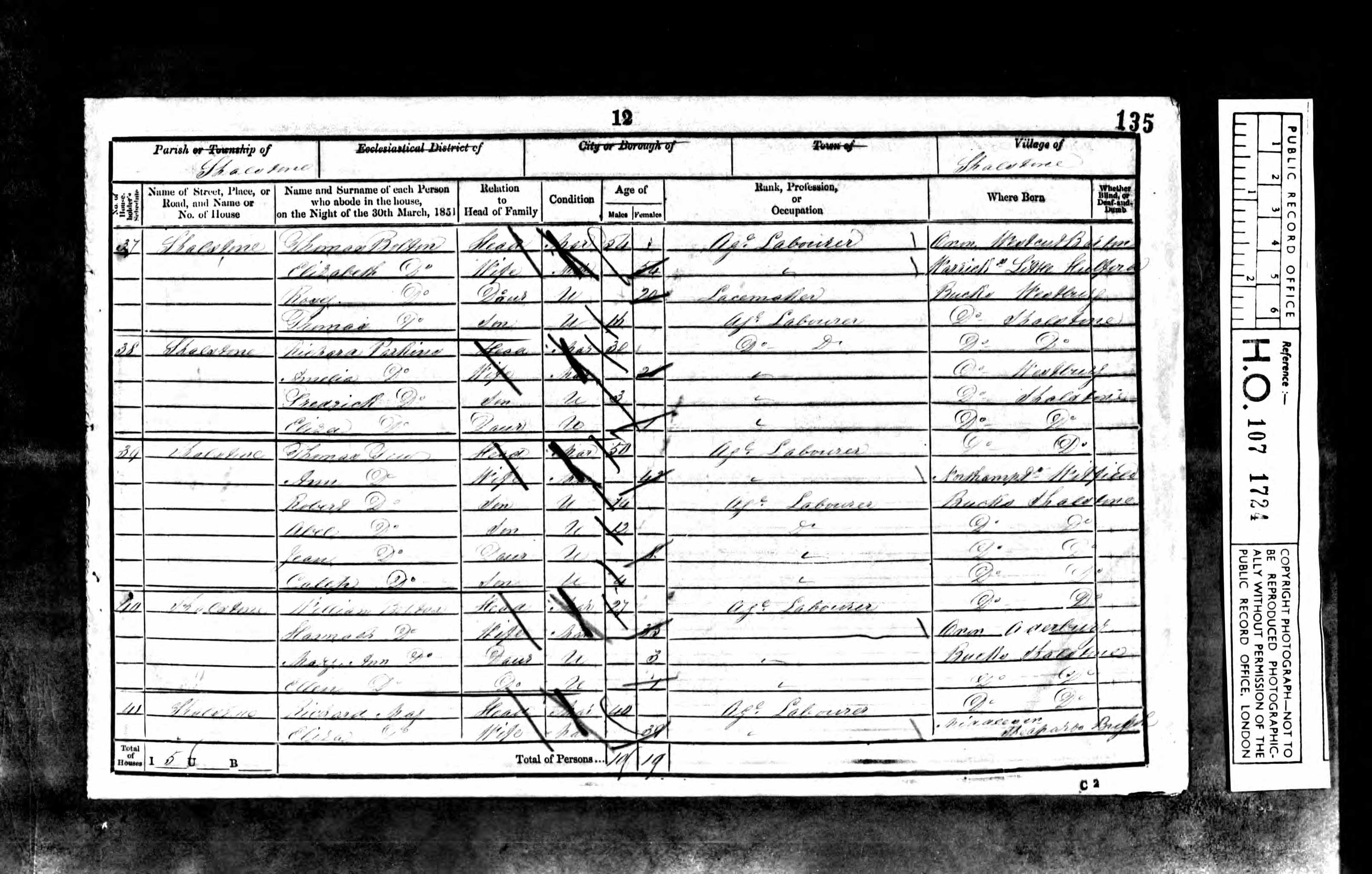
By 1851 the two eldest had gone from the household - George, now twenty-six, to make his own way, and Hannah to marry James Warr the year before. The census that year finds Thomas in Shalstonez2 with Ann and their four youngest: Robert and Abel, both agricultural labourers, Jane, and Caleb - a household sustained entirely by farm work.
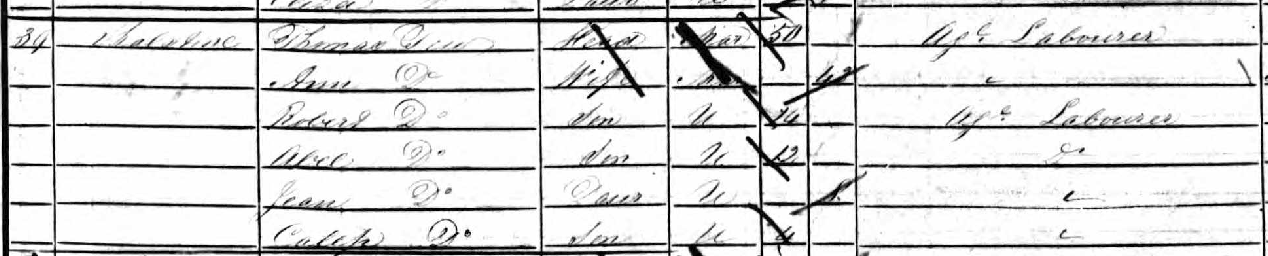
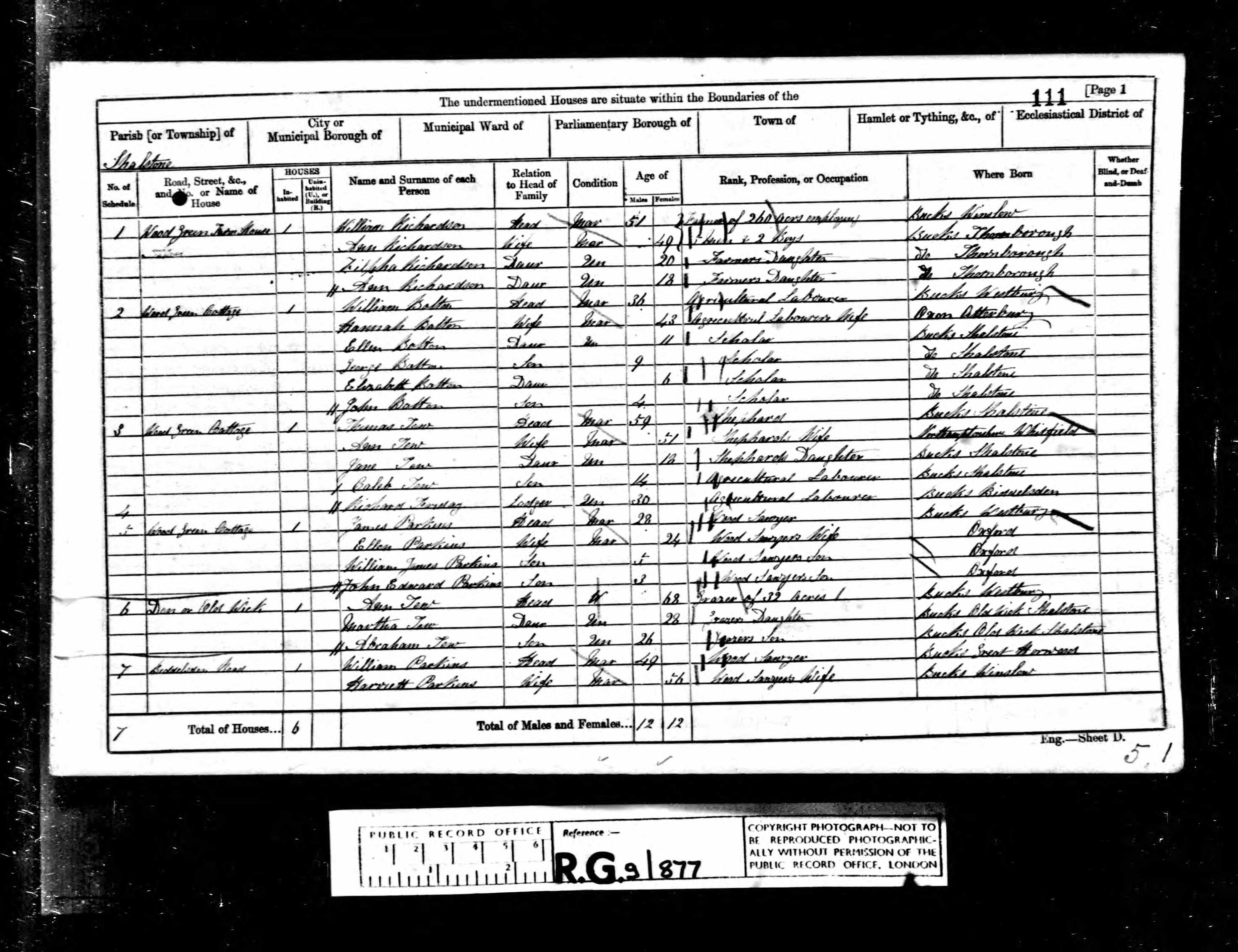
As they aged, Thomas and Ann moved out of the farmhouse to a cottage on the northern edge of the parish, a modest dwelling suited to an ageing shepherd and his wife. The 1861 census finds them at Wood Green Cottagex2 with only Jane and Caleb still at home.

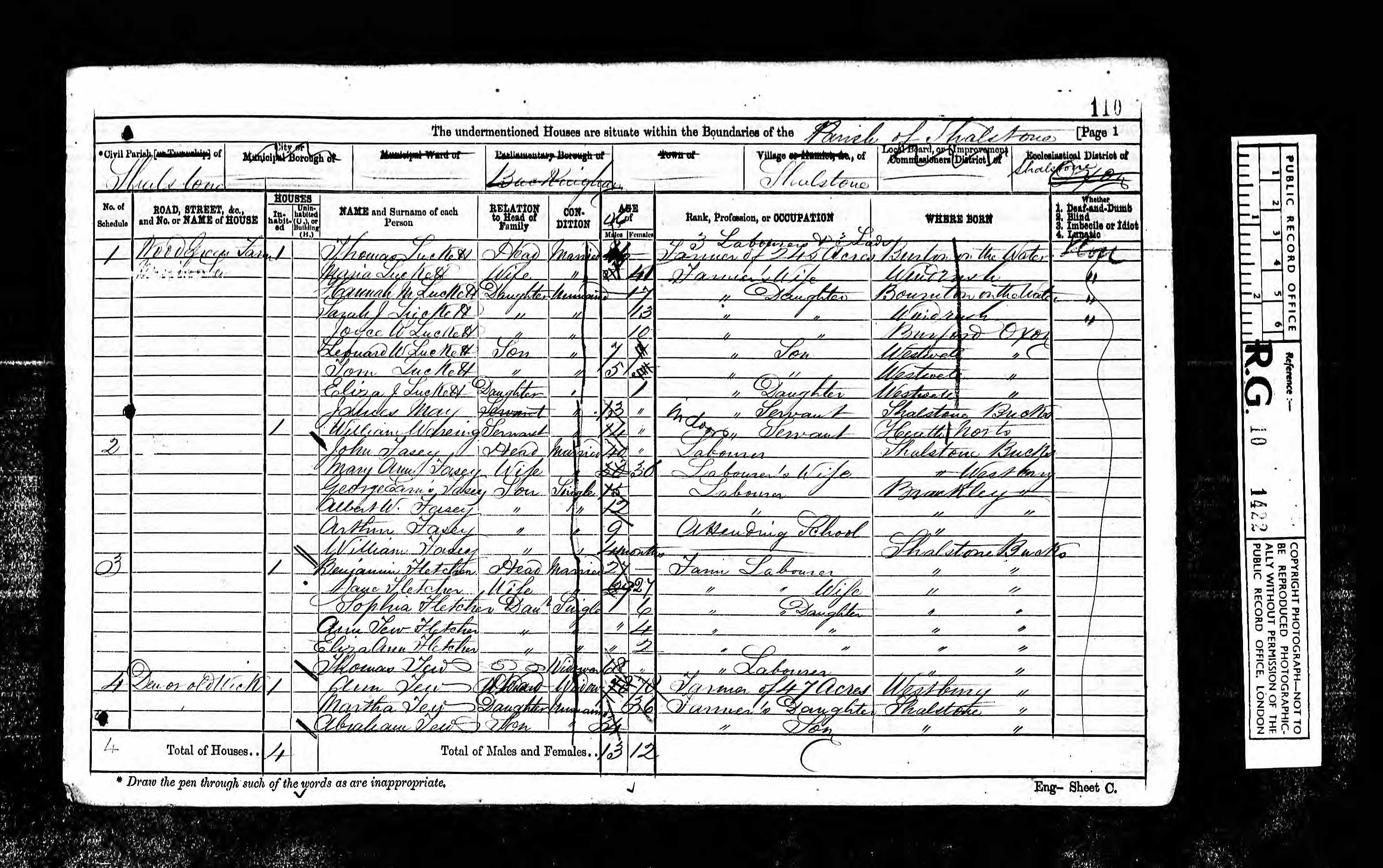
Ann Turvey died of liver cancer on 22nd May 1866 in Shalstoneb19 at the age of fifty-five, leaving Thomas a widower for the second time. By the 1871 census he had moved in with his daughter Jane and her husband Benjamin Fletcher at Wood Green farmw2. Jane had married Benjamin in 1864b17, a match that kept a familiar name in the family, since he was Lydia’s nephew, the son of her brother William Fetters or Fletcher. Benjamin was a farm labourer, Jane had three young daughters, and Thomas, now sixty-eight and himself recorded as a farm labourer, lived with them.
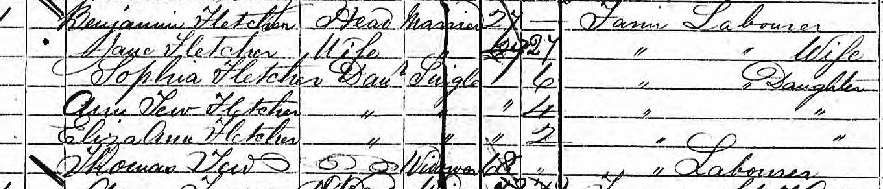
Old Wick, the neighbouring house, tells a longer story of the same years. The cousin George Tew was still grazing there in 1851, but he died the year after, in 1852. His widow - Ann, born Ann Keene - then took the land in hand herself and built it into more than a grazier’s plot: she was returned as a farmer of forty-two acres in 1861 and of forty-seven in 1871, living with two of her grown children. Thirty years on from the 1841 census the two branches were still neighbours - Thomas ending his working life as a labourer at Wood Green, his cousin’s widow farming her own acres next door at Old Wick.
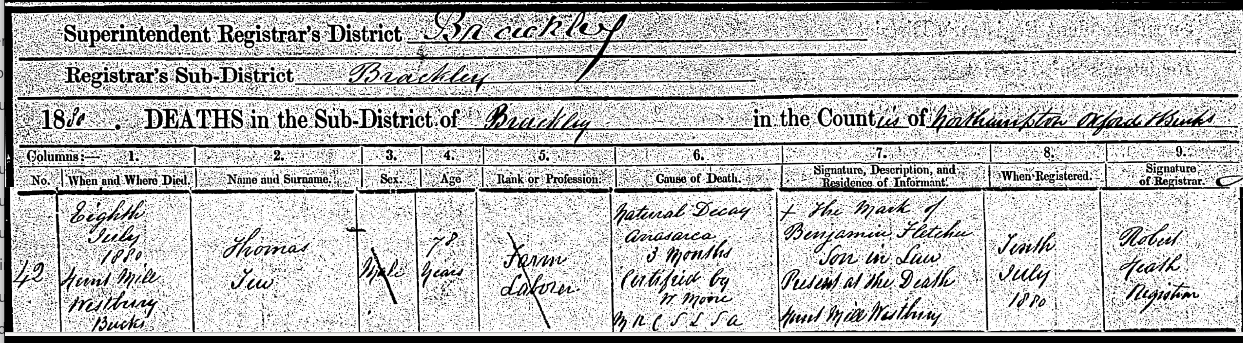
Thomas died on 8th July 1880 at Huntsmill in Westbury, Buckinghamshire, at the age of seventy-sevenb18. He was still living with his daughter Jane and her husband Benjamin Fletcher, whose household had by now moved from Wood Green to Huntsmill, and it was Benjamin, his son-in-law, who registered the death. His death was attributed to “natural decay” - a term used on death certificates of the period to indicate death through old age, without a specific identifiable disease. He lived to seventy-seven as a working shepherd in the mid-nineteenth century, when life expectancy for agricultural labourers was considerably lower.
The children’s later lives
Thomas and Ann’s children scattered as they grew, though most stayed within the belt of parishes where Buckinghamshire, Northamptonshire and Oxfordshire meet. Three of them lived into their eighties, long outliving both their parents.
Hannah, the eldest of the second family, had a shorter and harder life. She married James Warr, a carter, in 1850e16 and moved with him to Brackley, a market town a few miles north in Northamptonshire, where she bore eleven children. By the 1881 census she was widowed and working as a nurse, boarding in the household of a young couple with three small children of their own. Her own younger children were not with her - the youngest would have been only eleven - so the household she had built was already dispersed. She died later the same year, at about fifty.
Robert followed his father into shepherding. He married Susanna May in 1857e15 and the couple raised eight children in Shalstone, where he tended sheep as Thomas had done. Later in life he left the county altogether: by the 1901 census he and Susanna were living at Warlingham in Surrey with their youngest son, and Robert, by then in his sixties, had taken work as a gardener’s labourer. He died in the Croydon area early in 1925, at the age of eighty-ninee14.
Abel took up a trade rather than the land, becoming a shoemaker. The 1861 census found him boarding at Hemel Hempstead in Hertfordshire, but he did not settle there: he returned to Buckinghamshire and to the town of Buckingham, where he married Jane Smith in 1865e13 and the couple raised five children. He died in 1899e12.
Jane stayed in the same corner of Buckinghamshire all her life. She had married Benjamin Fletcher at Shalstone in 1864b17, and the couple lived at Wood Green in the early years of their marriage before moving on by short stages - to neighbouring Westbury by 1881, and to Water Stratford by 1891. She died in the Buckingham district early in 1926, at the age of eighty-foure11.
Caleb, the youngest, married Sarah Green in 1871bb1 at Whitfield, a few miles away in Northamptonshire, and was recorded as an agricultural labourer throughout his life. He moved often: from Whitfield to Syresham, then Purston, then Kings Sutton, and by 1891 to Middleton Cheney, where he died in 1929, at the age of eighty-threee10.
George Tew (1825-1908) and Catherine Whitehead (1834-1917)
Great great grandparents
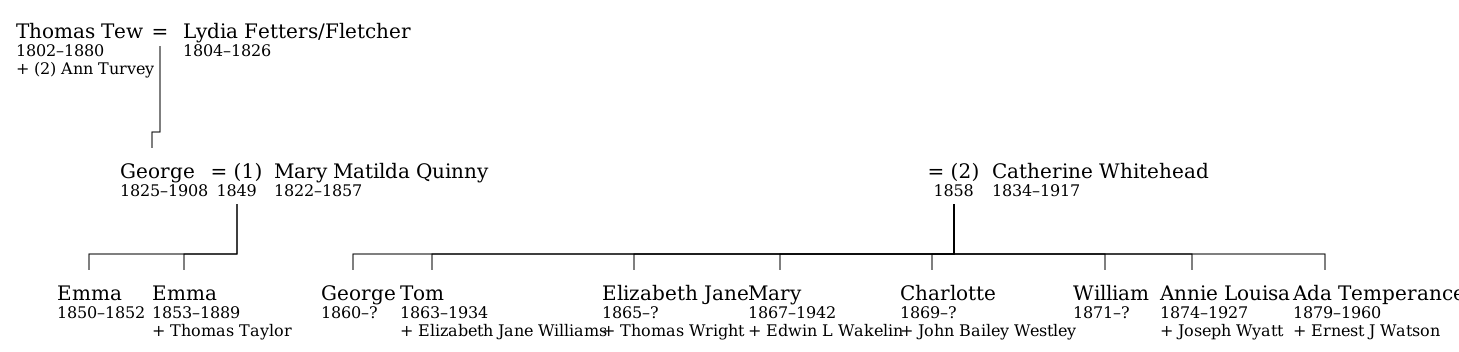
George Tew was baptised on 27th February 1825 at St. Edward’s Church in Shalstoneba1, the only known child of Thomas Tew and his first wife Lydia Fetters or Fletcher. His mother died when he was not quite two years old, and he grew up in his father’s household alongside the children of his father’s second marriage.
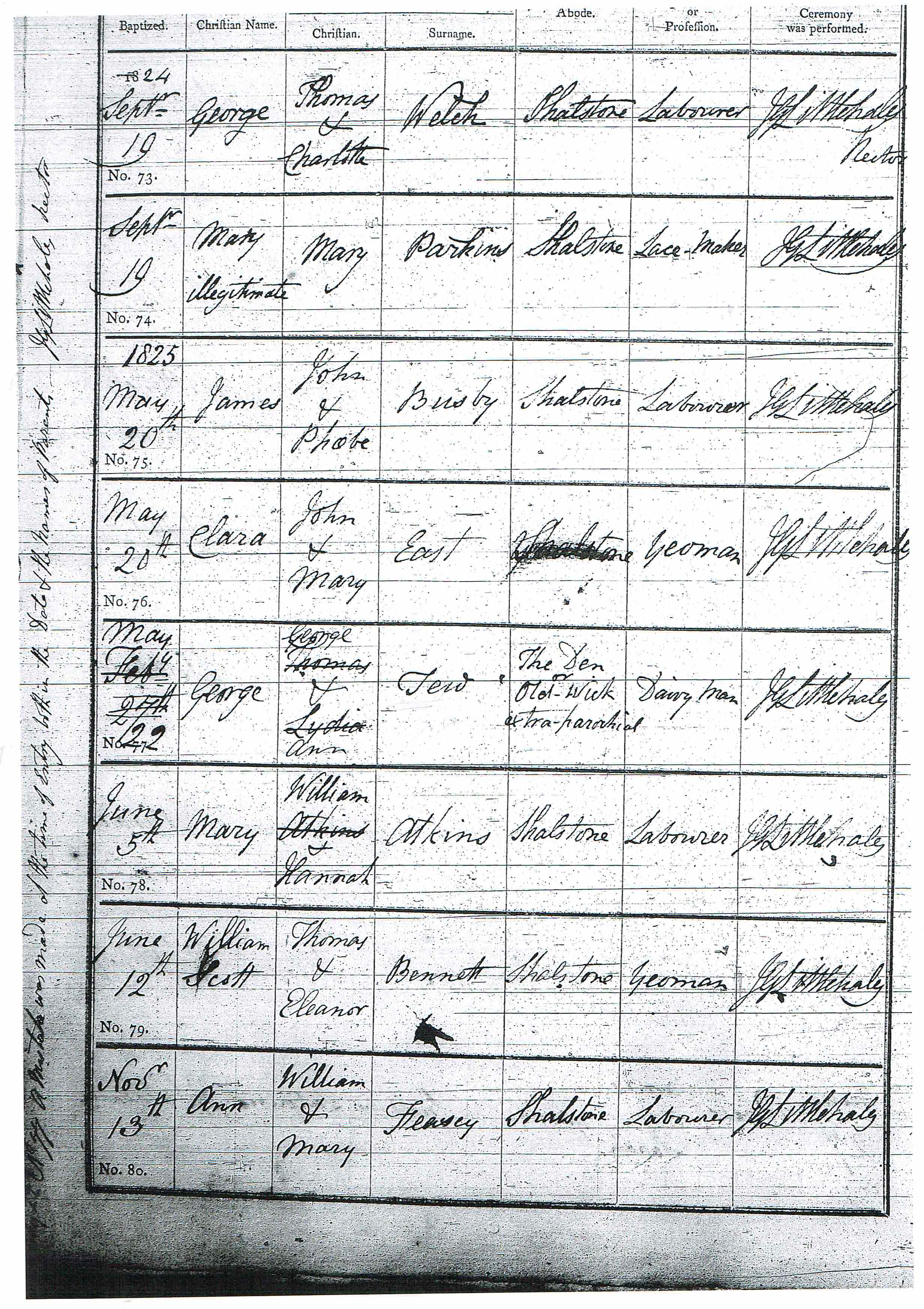
The baptism register preserves a moment of confusion between two George Tews baptised at Shalstone in the same year. George’s entry was written up with the abode “The Den or Old Wick, extra-parochial” and the father’s occupation “dairyman”, under the date 27th February and the names of Thomas and Lydia. Those details didn’t belong together: the Old Wick abode and the dairyman’s trade were those of Thomas’s cousin George Tew and his wife Ann Keene, who were baptising their own son - another George - that May. The rector, Joseph Gascoyne Littlehales, caught the mistake, struck out the date and the parents’ names, replaced them with “May 22, George and Ann”, and noted in the margin, “A mistake was made of the time of Entry within the date & the names of parents”. Our George, the son of Thomas the shepherd and Lydia, was baptised on 27th February 1825; the dairyman of Old Wick belonged to the grazier branch next door, not to his father’s household.

George’s working life was spent in agriculture, and the records describe him variously as a horsekeeper and an agricultural labourer. A horsekeeper was the man responsible for the farm’s working horses - the heavy draught animals that pulled ploughs, harrows and wagons. It was a position that carried a degree of status among farm workers, requiring skill and a good rapport with animals, and it was typically better paid than ordinary labouring.
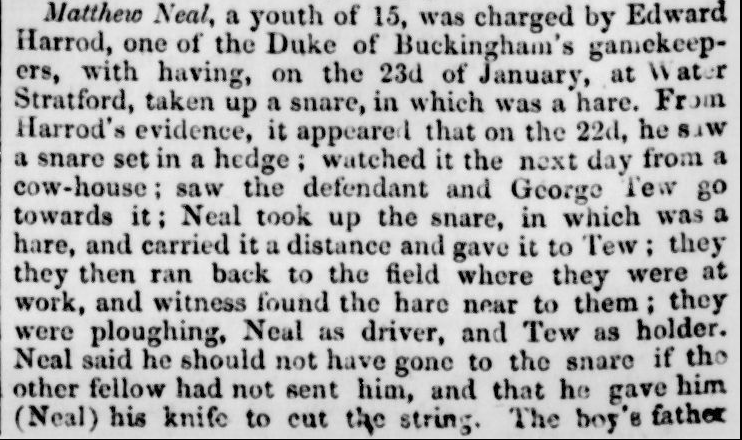
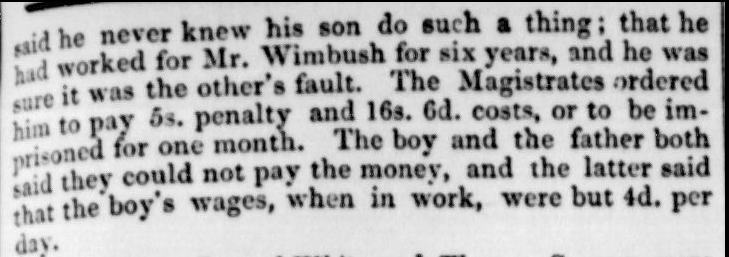
One episode may catch George as a young man. In February 1846 the Bucks Advertiser reported a case at Water Stratford in which a fifteen-year-old ploughboy, Matthew Neal, was convicted of taking a hare from a snare, watched from a cow-house by one of the Duke of Buckingham’s gamekeepers. Neal hadn’t acted alone: he was ploughing with a “George Tew” - Neal driving the team, Tew holding the plough - and it was Tew who sent the boy to the snare, lent him a knife to cut the string, and took the hare when he brought it back. Only the boy was charged; his father protested that the lad earned just fourpence a day and couldn’t pay the 5 shilling fine and 16s 6d costs.
Whether this George Tew was ours we can’t say, especially as a second George Tew of the same age - the grazier’s son from Old Wick - was living close by. But the fit is good: our George was a landless labourer of about twenty in 1846, and Water Stratford is exactly where the census of 1851 would find him at farm work. A hired ploughman there suits him better than the grazier’s son, who had his family’s own ground to work.
Mary Matilda Quinny
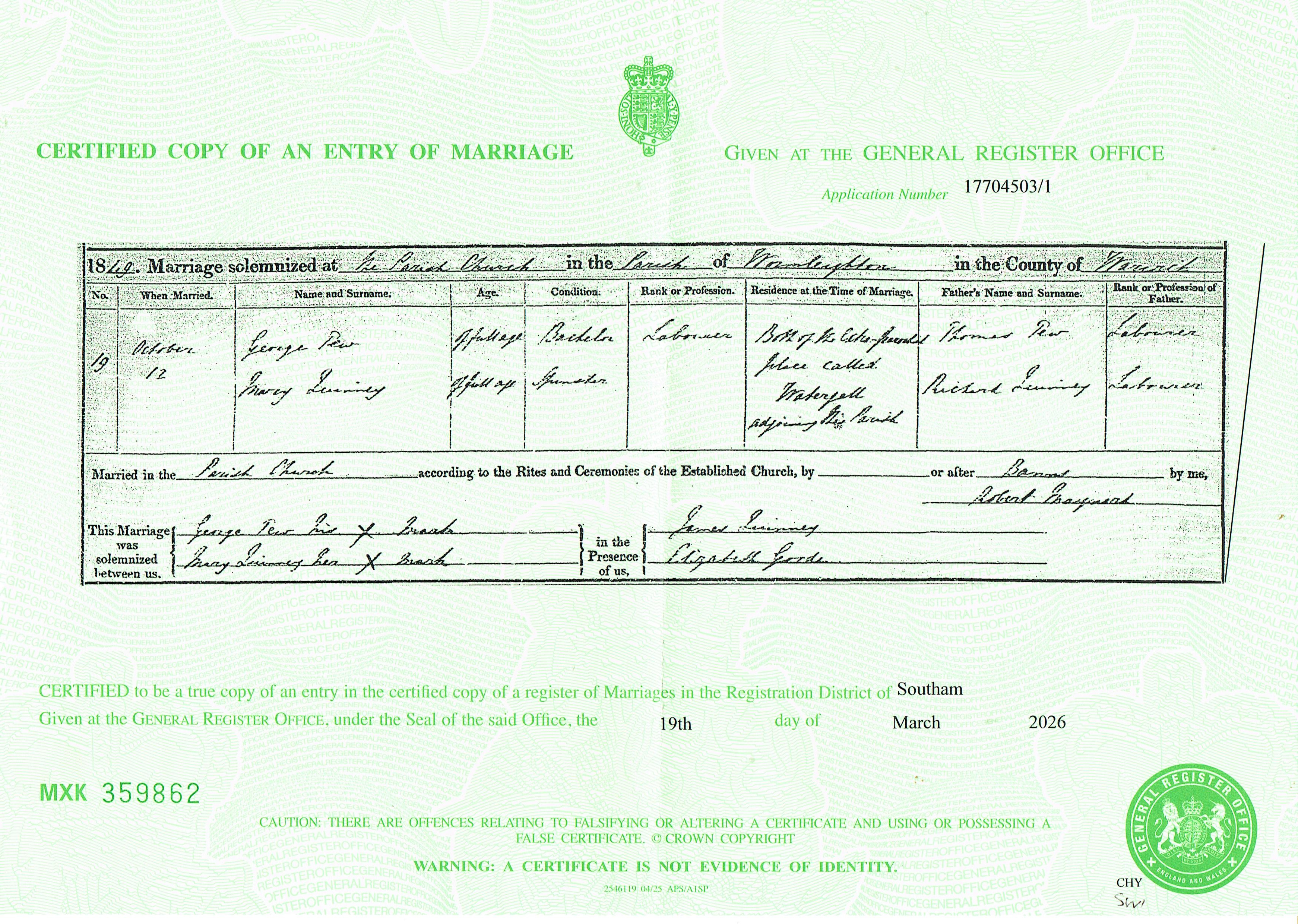
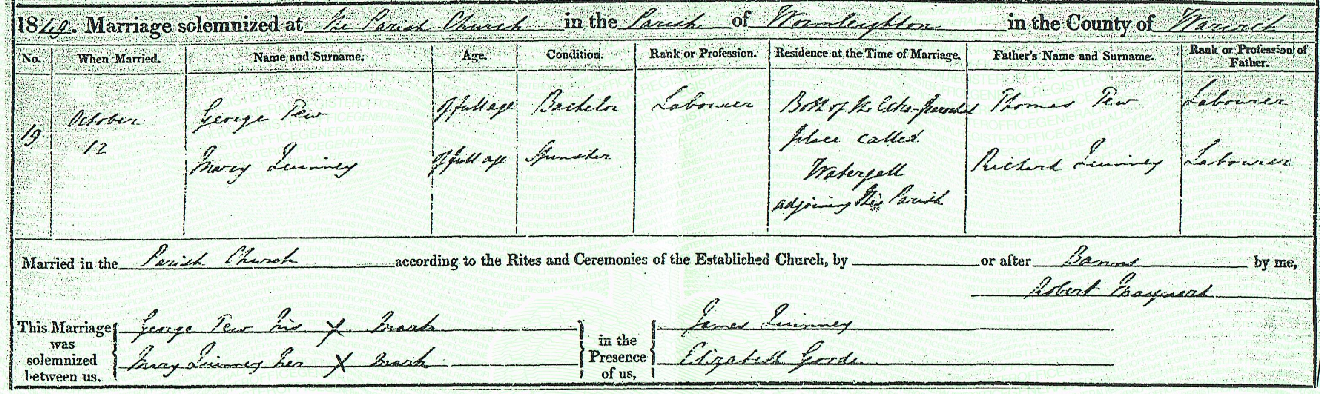
George’s first marriage was to Mary Matilda Quinny (1822-1857), whom he married on 12th October 1849 at St. Peter’s Church in Wormleighton in Warwickshireb16.
George, recorded as a labourer, was described as a bachelor and Mary as a spinster, and both were resident in Watergall, an extra-parochial place adjoining Wormleighton parish. One of the witnesses was Mary’s brother James. Neither George nor Mary could sign their name, and both made their mark. Watergall was a tiny, isolated settlement - little more than a farm or two - lying in open country between the parishes of Wormleighton and Priors Hardwick. That George had moved from the Shalstone area to this remote spot in south-east Warwickshire, some twenty miles to the north-west, suggests he had found work as a farm servant or labourer on one of the estates in the area. Extra-parochial places like Watergall fell outside the normal parish system.
Mary came from Mollington, a small parish in Oxfordshire just across the county boundary from Buckinghamshire, where her father Richard Quinny was an agricultural labourer. Her mother, Elizabeth Culcott, died and was buried on 4th February 1850, just weeks after Mary married George. This left Richard a widower with his sons James and Thomas and several grandchildren.
The couple had two daughters, both named Emma. The first Emma was baptised on 23rd June 1850 at St. Edward’s Church in Shalstoney7. By the time of the 1851 census, however, the young family was living apart. George was recorded alone in Water Stratford, a parish neighbouring Shalstone, working as an agricultural labourerz1. Mary, meanwhile, was back in Mollington with ten-month-old Emma, living in her widowed father Richard’s household. Richard was sixty-six, and with him were his sons James (twenty-six) and Thomas (twenty-one), and two granddaughters, Betsy and Jane, aged ten and seven. Mary was the only woman in the household, and it seems likely she had returned to Mollington to help care for the children after her mother’s death the previous year. The arrangement may also have reflected the practical difficulties of a young labourer’s wife managing alone while her husband worked on a farm some distance away.
Their daughter Emma died in February 1852 in Mollington and was buried there on 19th February. The burial register records that she died at Mollington but gives her abode as Buffer’s Holt in Water Stratford - a small, isolated spot in the Buckinghamshire countryside where the family was evidently living, or at least where George was based. That the child died at Mollington rather than Buffer’s Holt suggests she was still with her mother at her grandfather’s house.
George and Mary had a second daughter, also named Emma - a common practice when an earlier child of that name had died - born on 16th October 1853 in Water Stratfordb15. At the birth registration George was noted as a labourer. This second Emma’s later life offers a link to the family George would marry into. In the 1881 census she was recorded as Emma Kent Tew, living in Greens Norton with Jane Foster, a widow who had been born Jane Whitehead - the sister of Catherine (Kitty) Whitehead, who by then was George’s second wife. The connection suggests that the Tew and Whitehead families were already known to one another, and perhaps that Kitty’s sister Jane played a role in caring for George’s daughter from his first marriage. Emma went on to marry Thomas Taylor in 1881e9 and had three children before dying of phthisis - pulmonary tuberculosis - at just 36 in 1889b14. She was buried in Greens Norton.
Mary Matilda died on 25th June 1857 in Water Stratfordb13 at the age of thirty-four. Her death was attributed to mesenteric disease - tuberculosis of the abdominal lymph nodes, a condition often contracted through drinking infected cow’s milk. It was a common affliction in rural communities where unpasteurised milk was a dietary staple, and it could be a slow and painful illness. George was left a widower with a young daughter - a painful echo of his own father’s experience a generation earlier.
Catherine “Kitty” Whitehead
Catherine Whitehead, known as Kitty, was baptised on 9th March 1834 in Westburyy6, the daughter of William Whitehead (1803-1863), a labourer, and Temperance Russel (1806-1859). That Catherine’s mother bore the unusual Puritan name Temperance is another small hint of the Nonconformist strain that ran through these communities.
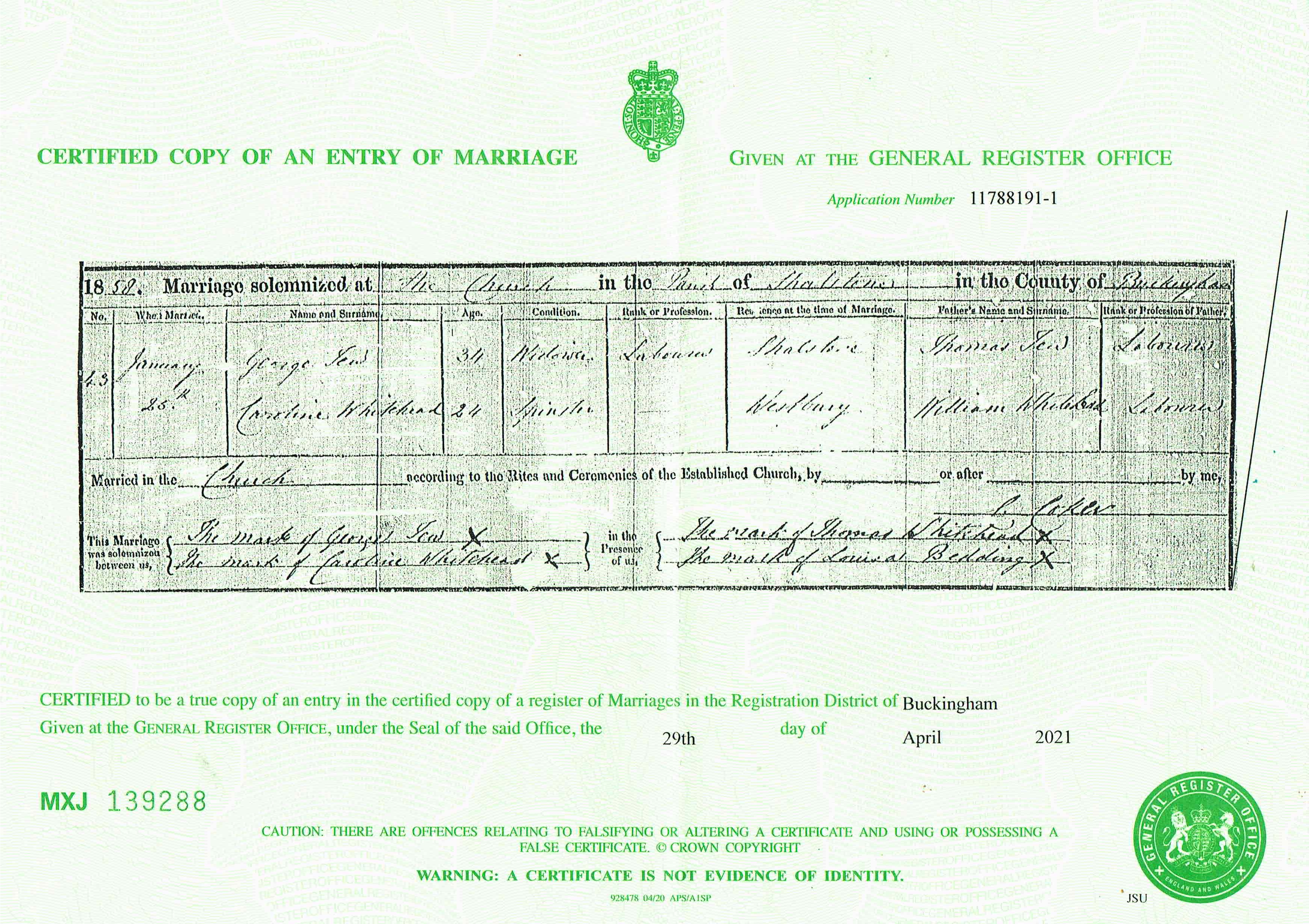
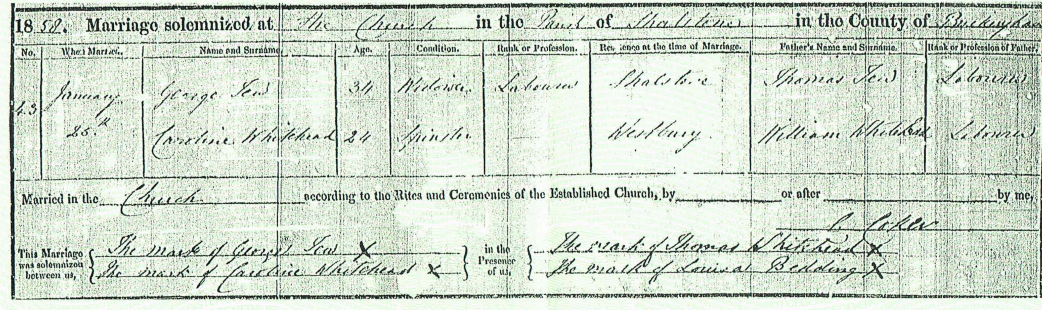
George married Catherine on 28th January 1858 in Shalstoneb12. He was a widower of thirty-four, a labourer living at Shalstone; she a spinster of twenty-four, living at Westbury. The register records her name not as Catherine but as “Caroline”, and since neither she nor George nor the witnesses could write, the slip went unnoticed and uncorrected. The witnesses were Thomas Whitehead, probably Kitty’s younger brother, and Louisa Bedding, her cousin. Together George and Catherine had eight children, and this second marriage began a long journey that would take the family progressively eastward, out of rural Buckinghamshire and into Northamptonshire.
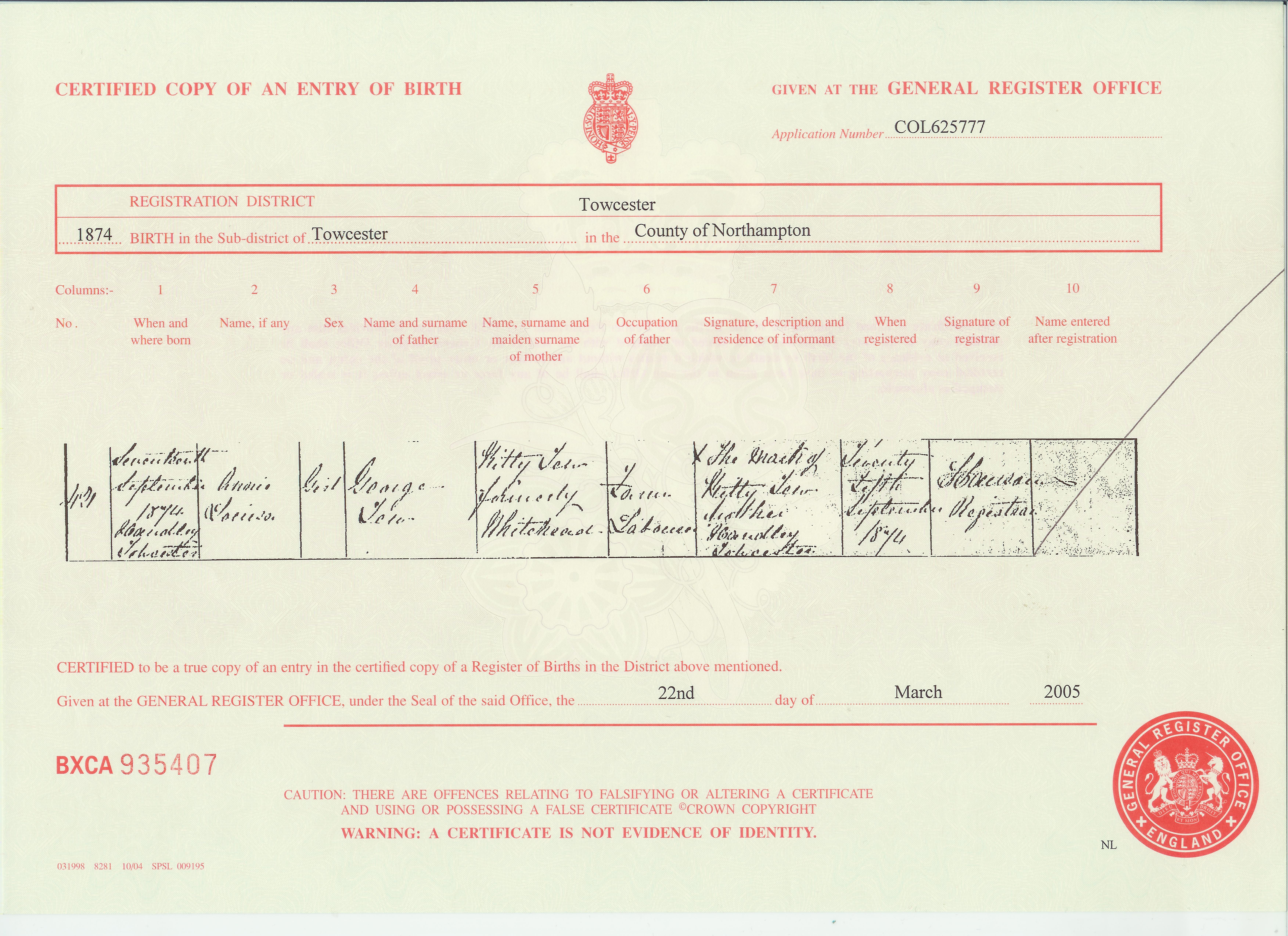
Their eldest son George was baptised on 9th September 1860 in Westburyy5, and Thomas followed on 3rd May 1863y4. Three daughters came next: Elizabeth Jane, born on 2nd April 1865y3, Mary, born on 21st May 1867y2, and Charlotte, born on 21st July 1869y1 - all three baptised together on 4th May 1870. William was born in 1871 in Handley near Towcestere8. Annie Louisa, Steph’s great grandmother, was born on 17th September 1874 in Handleyr1, followed by the youngest, Ada Temperance in 1876 in Greens Norton, whose middle name again echoes Catherine’s motherr2. Both girls were baptised together on 26th October 1879 in the parish of Edgcote, Northamptonshirer1r2.
None of the three girls was baptised where she was born. As the family moved for work they came in turn to Crowfield in Syresham, where Elizabeth Jane was born in 1865, to Brackley, where Mary followed in 1867, and to Greens Norton, where Charlotte was born in 1869 - yet Catherine held off christening any of them until she could bring all three back together to St. Augustine’s in Westbury, her own home church, in 1870. By then Elizabeth Jane was five and Mary nearly three. She made the journey even though the ties that had bound her to the parish were gone: her mother Temperance had died in 1859 and her father William Whitehead in 1863. What drew her back was the church of her own childhood. The same habit of saving up children for a single late baptism showed again nine years later, though nearer to hand, when Annie Louisa, also five, was received into the church at Edgcote alongside Ada Temperance.
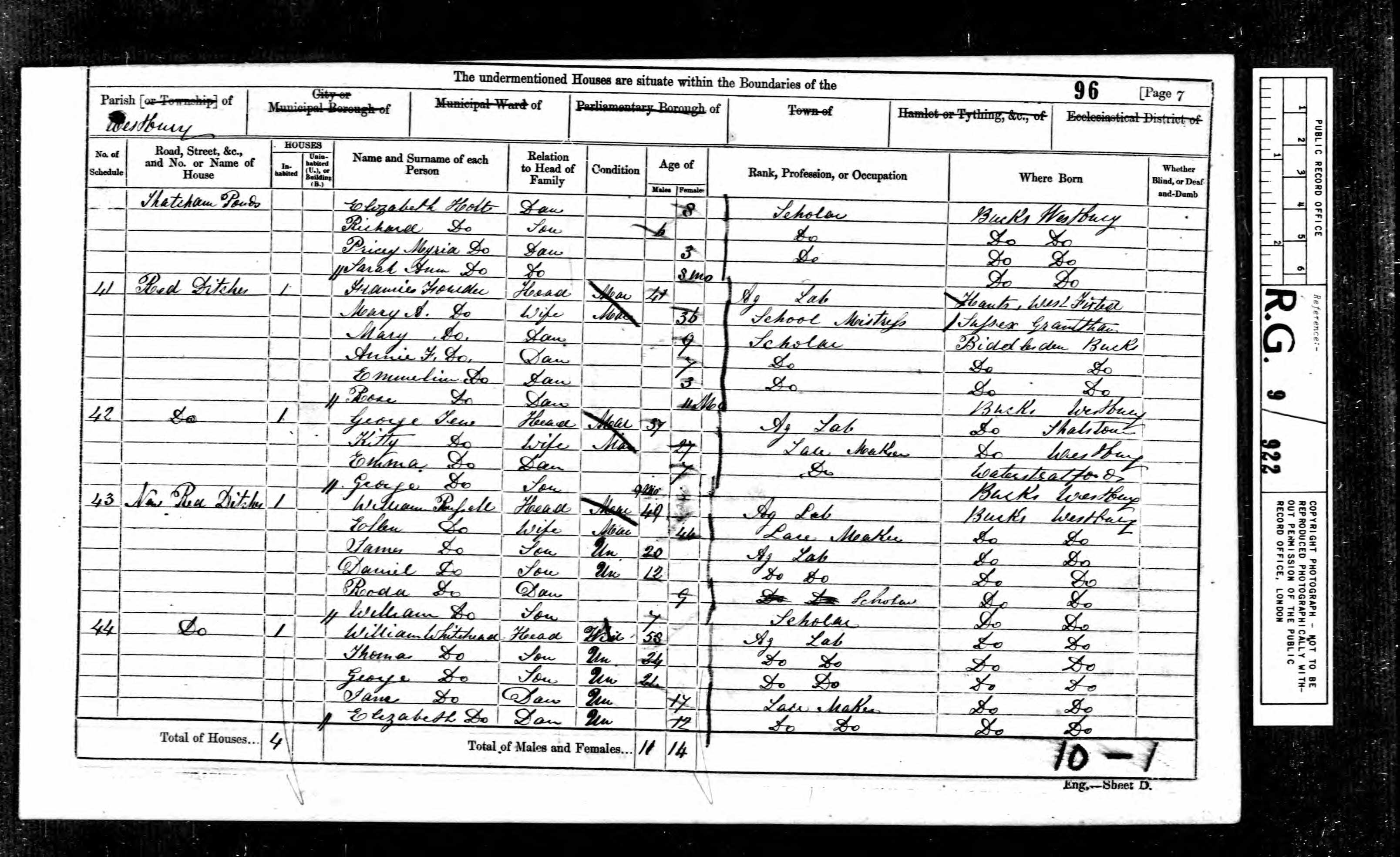
The census returns trace the family’s gradual migration. By 1861, George was at Red Ditches in Westburyx1 with Catherine, his daughter Emma Kent Tew from his first marriage (described as a lacemaker, and now seven years old), and their son George. The presence of lacemaking in the household is no surprise: bobbin lace had been a major cottage industry in this part of Buckinghamshire and Northamptonshire since the sixteenth century, introduced by Flemish and French Protestant refugees. Women and girls worked at their lace pillows, often in doorways for the light, producing the delicate “Bucks Point” lace that was sold through dealers at market towns like Buckingham and Newport Pagnell. By the mid-nineteenth century the trade was in slow decline, undercut by machine-made lace, but it still provided essential supplementary income for labouring families.
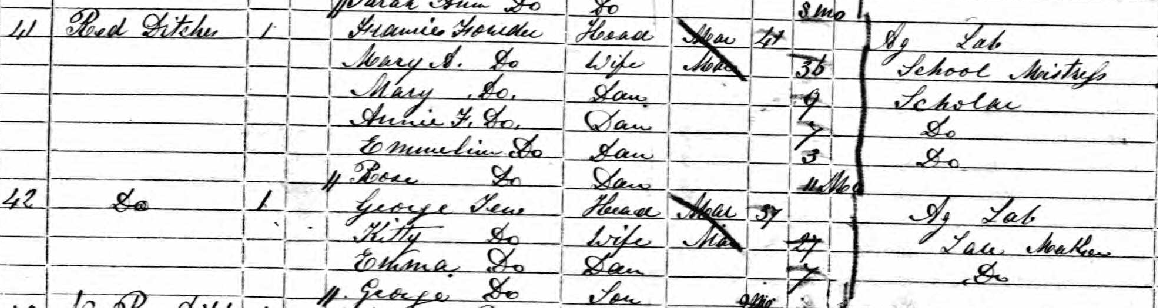
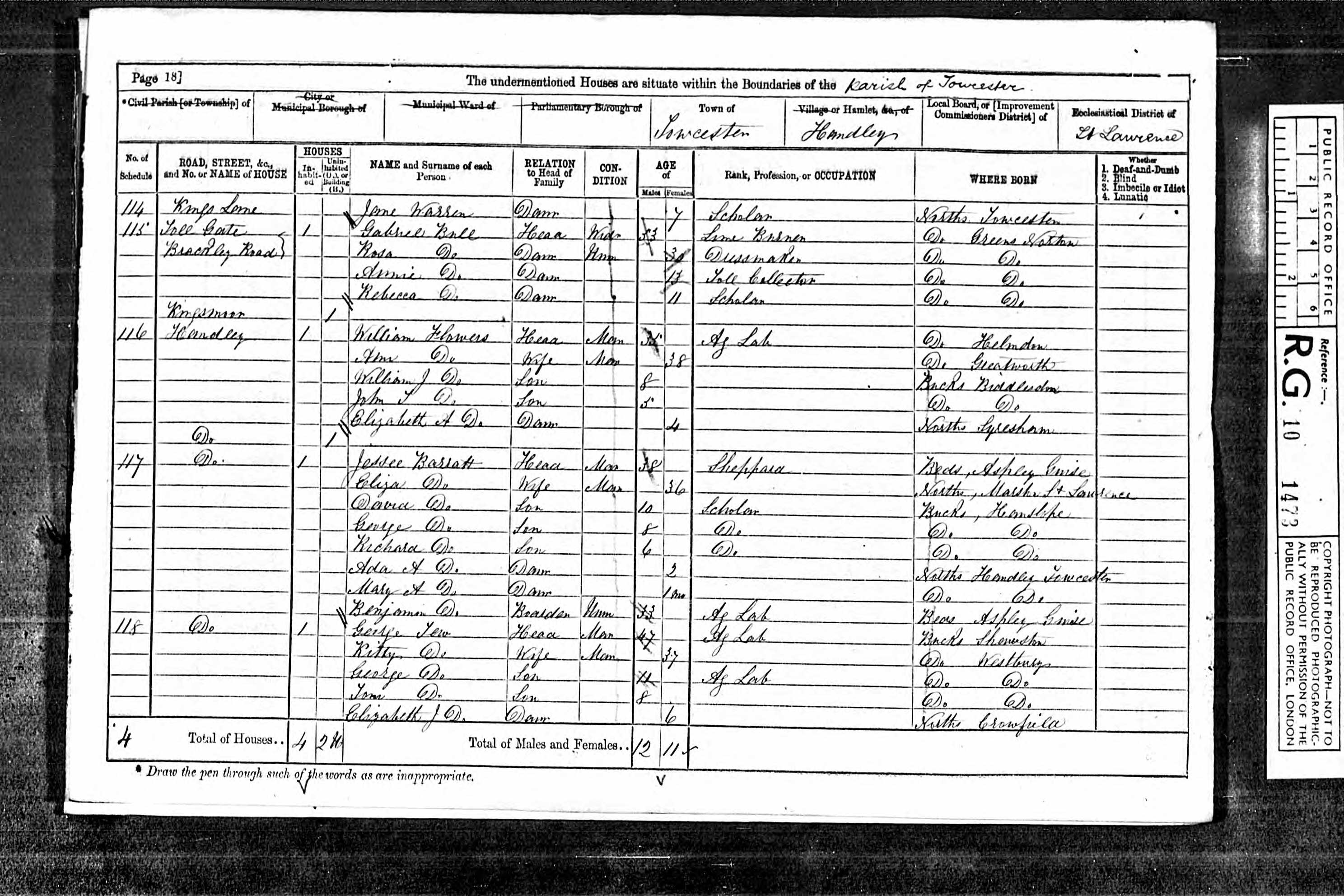
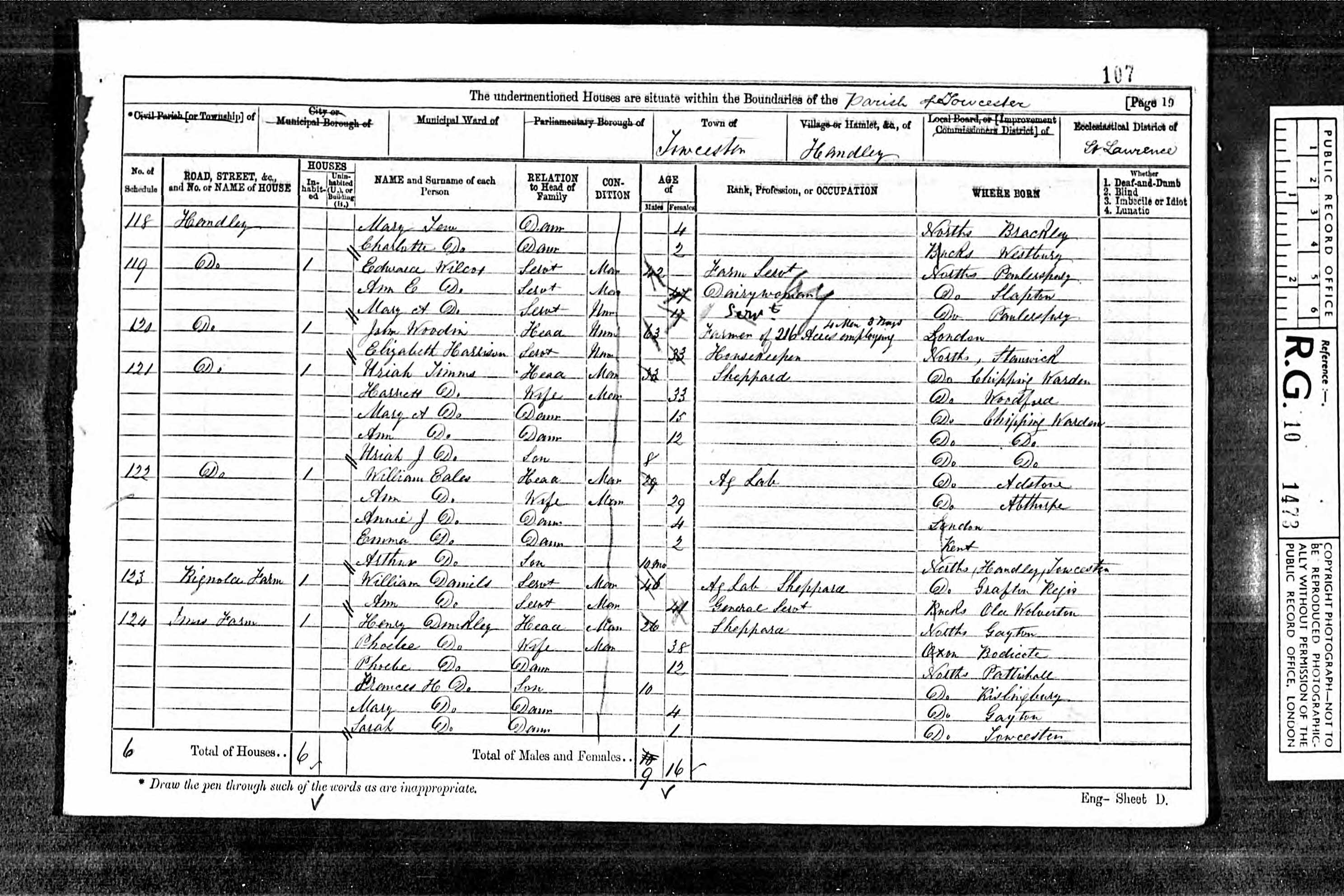
By 1871, the family had moved to Handley in Towcester, Northamptonshirew1. George was there with Catherine and five children: George (now an agricultural labourer in his own right), Thomas, Elizabeth Jane, Mary, and Charlotte. The move from Buckinghamshire into Northamptonshire - a distance of perhaps ten or fifteen miles - would have been prompted by the search for work. Towcester was a small market town on the old Roman road of Watling Street, and the surrounding countryside offered employment on the larger estates.


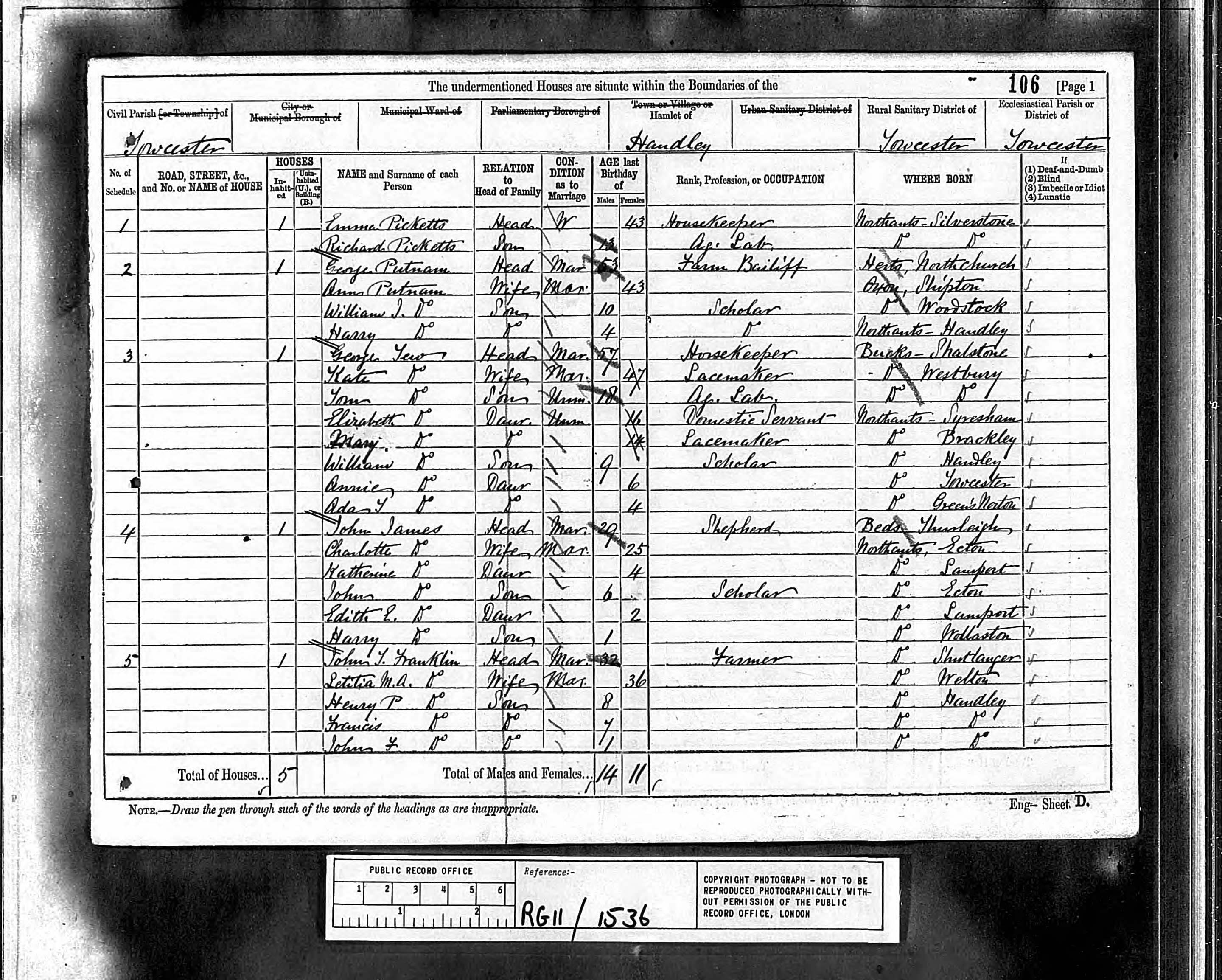
The 1881 census shows the family back at Handleyp2, with George now recorded as a horsekeeper. Catherine was entered under the name Kate, and was working as a lacemaker, as was her daughter Mary, now fourteen - the trade still lingering on in the household. Elizabeth Jane, sixteen, was a domestic servant, and Thomas an agricultural labourer. The three youngest were William, Annie Louisa - Steph’s great grandmother, then a girl of six - and Ada Temperance, aged four.
The birthplaces recorded on the return trace how far the family had moved over the years. George was born at Shalstone and Kate at Westbury, as was their eldest son Thomas; Elizabeth Jane was born at Syresham, Mary at Brackley, William at Handley, Annie Louisa at Towcester, and Ada Temperance at Greens Norton. Annie Louisa’s birthplace is given here as Towcester rather than Handley, which makes it possible the family was then living at a dwelling nearer the town - Handley being not a village but a scattering of hamlets and farms to the west of Towcester, so the two need not have been far apart.
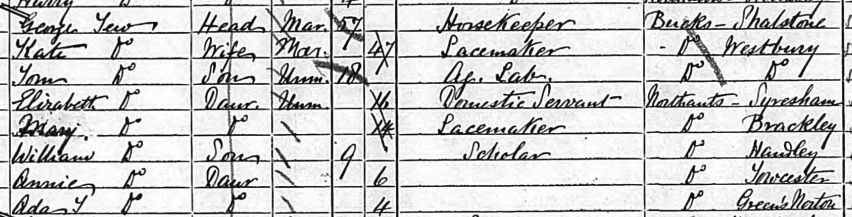
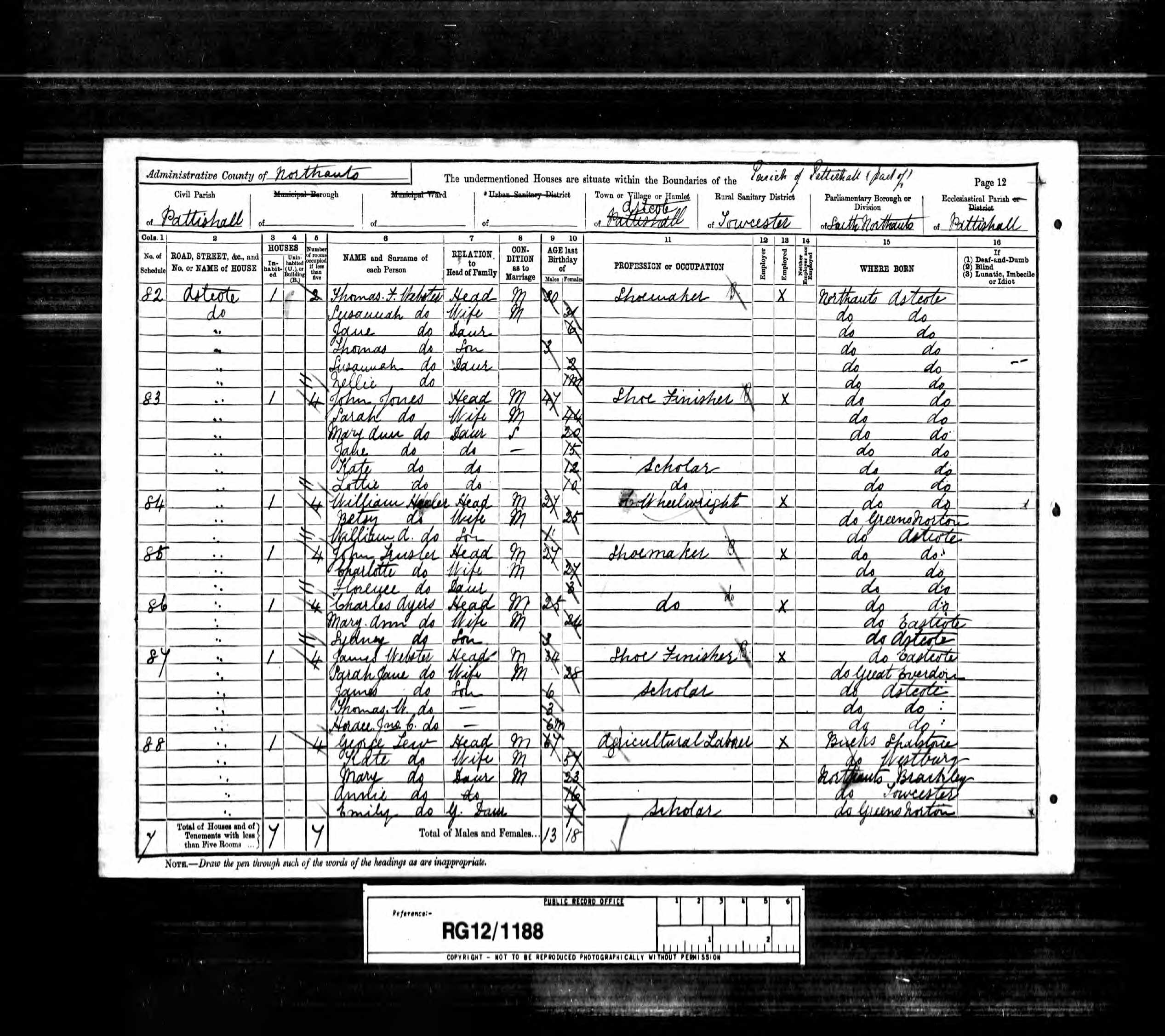
By 1891, the household had contracted as children married and moved away. George and Catherine were living in Astcote in Pattishall, Northamptonshirem2 with only Annie Louisa and Mary still at home. Astcote and Pattishall were quiet agricultural villages north of Towcester, and the family’s continued presence in this area suggests steady, if unremarkable, employment on the land.

In 1901, George and Catherine had moved to Chapel Yard in Greens Norton, Northamptonshirek3, living alone as an elderly couple. Greens Norton was a village near Towcester with a long history - it had been a royal manor in the time of Edward the Confessor, and its church of St. Bartholomew dated from Norman times. By the late nineteenth century it was a modest agricultural community.
Later years
George died on 1st November 1908 in Greens Nortonb11 at the age of eighty-three, though the entry records his age as eighty-six. His death was attributed to “senile decay”b11, a term that covered death through old age and possibly included what we would now recognise as dementia. The informant was his daughter Mary Wakelin, who was present at the death and living at Greens Norton too. Like his father before him, he proved long-lived for a man of his class and occupation.

Catherine lived on as a widow. In the 1911 census she was still in Greens Nortond3, but at some point afterwards she moved to Northampton to live with her daughter Annie Louisa at 17 Leicester Street. She died there on 17th June 1917b10, also at the age of eighty-three, also from “senile decay”b10.
Of the eight children George and Catherine raised, we can follow most into adult life, though for some little survives beyond a marriage entry.
The eldest son, George, married Agnes Elizabeth Capel in 1880 at Wardington in Oxfordshirev1. The witnesses were his half-sister Emma - the daughter of their father’s first marriage - and Thomas Taylor, whom she would marry the following year, a sign of how close George and Emma had stayed. By the 1881 census both were living in Greens Norton, while the rest of the family were still at Handley a few miles off: George was an agricultural labourer in High Street, living with Agnes and her one-year-old son Richard William Capel. He and Agnes had a daughter of their own, Emma Louisa Tew, in 1883 - very likely named for the half-sister living close at hand. The marriage was brief: Agnes died in 1885, leaving George a widower with a small child. With Emma settled nearby, he may well have relied on her to help raise the girl who bore her name. When Emma herself died in 1889, that help was gone, and it may be from about this point that George moved to Kettering, where his other sister Elizabeth Jane had settled. The rest of his life survives only in the record of his daughter’s death: Emma Louisa died in 1898, aged fourteen, of meningitis in the infectious diseases hospital at Kettering, with her aunt Elizabeth Jane - by then married to Thomas Wright and settled in the town - present at the end. The certificate notes that George was already dead, a farm labourer of Kettering, so he had indeed moved to the town where his sister lived, and had died there before his daughter.
Thomas spent his whole life in and around Greens Norton, working on the land as his father had. He married Elizabeth Jane Williams on 5th August 1884 in Towcesterb9, and the couple had six children, all sons. In 1891 his younger brother William, also an agricultural labourer, was lodging with him at Handley, the hamlet just south of Greens Norton where the family had settled. By the 1911 census Thomas was at Chapel Yard in Greens Norton, a farm labourer with Elizabeth Jane and four of their sons, all still unmarried; on that return he gave his birthplace as Red Ditches, the house near Westbury where his parents had been living in 1861. He died in 1934 in the Towcester area, at the age of seventy-onee7.
Elizabeth Jane married Thomas Wright, a shoe finisher, on 14th September 1890 at St. Andrew’s Church in Ketteringu1, and remained in the town - by then one of Northamptonshire’s busy boot and shoe centres, where a finisher trimmed and blacked the edges and soles of the made-up footwear. Her later life took an unusual course. In 1901 she was recorded as a “visitor” in the household of William Sharp, a gas stoker, and by 1911 she was keeping house for him at another Kettering address, still describing herself as married though her husband was not with her. Sharing the house in 1911 were her fourteen-year-old niece Rose Wakelin - Mary’s daughter - boarding while she worked as a table girl in a factory, and Sharp’s own young son, who was not hers. The arrangement lasted: in 1921 she was still Sharp’s housekeeper, and by then a widow. She died in 1938, at the age of seventy-threee6.
Mary, known in the family as Polly, married Edwin L Wakelin, a labourer, on 21st December 1896 at the Register Office in Towcesterb8; both were living in Greens Norton at the time, and her sister Elizabeth Jane stood as a witness. They had three children. In 1901 the family was at Greens Norton with two of them, and Mary’s nephew Harry Tew - one of Thomas’s sons - was lodging with them. By 1911 her situation had come to resemble her sister’s: recorded as married but with her husband no longer present, she was keeping house at Abthorpe for Francis Matthews, a widower with two young daughters, with two of her own children in the house. Edwin had died by the early 1920s: by 1921 Mary had married again - to William Brown, a timber carter - and was living with him in Northampton with three of her children. The couple were still there in 1939. Mary died in 1942, at the age of seventy-five.
Charlotte married John Bailey Westley, a shoemaker and a widower twice her age, on 13th October 1890 at St. Mary’s Church in Burton Latimert1, where both were living; the 1891 census sets him down as a riveter, one of the men who fastened soles to uppers in the boot and shoe trade. The marriage produced no children, and John died early in 1900. By the census of 31st March 1901 Charlotte had moved to Kimbolton in Huntingdonshire, boarding there with Frederick Henman, a bricklayer, and an eight-month-old boy, also Frederick; she and Henman were both recorded as married, though they did not in fact marry until 1912. Their family grew quickly - by 1911 they were at Rothwell, near Kettering, with seven children - and moved about: back to Burton Latimer by 1921, then to Northampton by 1939, where Charlotte was living with Frederick Henman and two of their children. Henman died in 1945 at Kettering; Charlotte died in 1951 at Northampton, at the age of eighty-one.
Ada Temperance, the youngest, was in domestic service when she married Ernest J Watson, a shoemaker, on 5th August 1895 at All Saints Church in Harpoles1; her brother William was a witness. The couple made their home a few miles away at Kislingbury, west of Northampton, where they raised six children and where Ada lived out the rest of her life. She died in the last quarter of 1960, at the age of eighty-one; the death was registered at Brixworth, the district that covered Kislingburye5.
Though the children scattered as they grew - to Kettering and Rothwell, Abthorpe and Kislingbury, and as far as Kimbolton across the Huntingdonshire border - they plainly kept in touch. They stood as witnesses at one another’s weddings, took each other’s children in as boarders and lodgers, and more than once settled in the same towns. The records preserve only the contacts that happened to be written down; behind them must lie a steady traffic of letters and visits between the households. For a labouring family spread across the county and beyond, they stayed about as close-knit as their circumstances allowed.
Taken together, the daughters’ later lives show how loosely the census categories could sit over the reality. Elizabeth Jane and Mary each spent years keeping house for men who were not their husbands while still returning themselves as married, and Charlotte lived with Frederick Henman as his wife for more than a decade before they married in 1912. Their sister Annie Louisa, whose story fills the next chapter, had three children outside marriage before she too married in 1912. For working women with little property and less security, a household was held together by whatever arrangement served, and the marital status set down by the enumerator often concealed a more improvised domestic life.
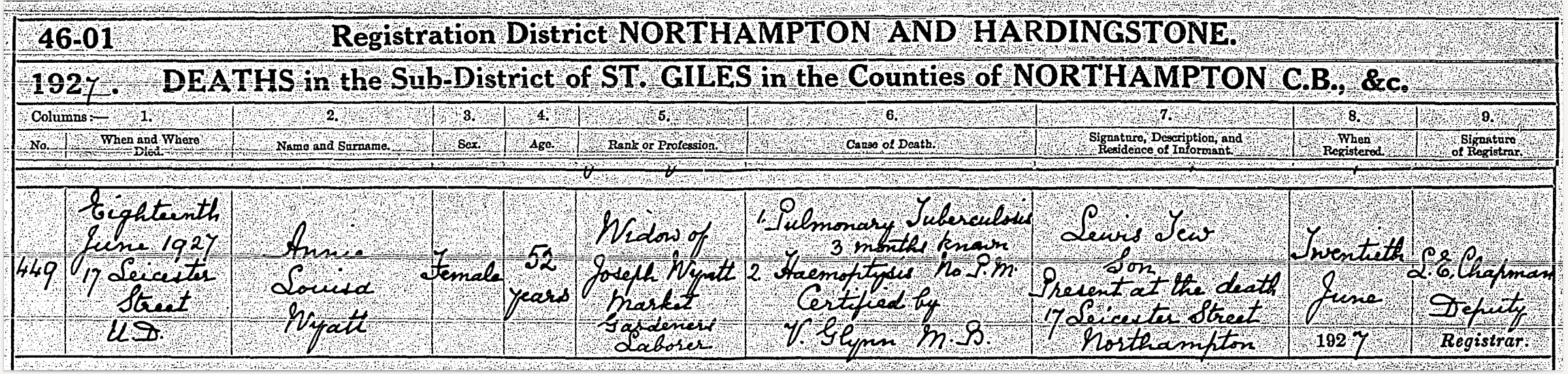
Tuberculosis appears more often than any other cause of death in these records. Emma died of it in 1889, as her mother Mary Matilda had in 1857 - though of different forms: Mary’s was the mesenteric type carried in the milk of infected cows, Emma’s the pulmonary consumption passed from person to person. The disease followed the family into the town as well. Emma’s half-sister Annie Louisa, whose story fills the next chapter, died of pulmonary tuberculosis in a Northampton terrace in 1927, and her daughter Florrie of the same disease in 1939, aged only twenty-three. TB was caught, not inherited; its recurrence here reflects how the family lived - close quarters and shared beds, and in the dairying country the milk of tubercular cows - rather than any inherent susceptibility.
Annie Louisa Tew (1874-1927) and Herbert Goode Rogers (1876-1951)
Great grandmother

Annie Louisa Tew was born on 17th September 1874 in Handley, near Towcesterb7, the daughter of George Tew and Catherine Whitehead. She was one of the younger children in a large agricultural family and was baptised late, along with her sister Ada Temperance, on 26th October 1879 in Edgcoter1 - by which time she was already five years old.

In the 1881 census, she was living at Handleyp2 with her parents and five siblings. By 1891, now sixteen, she was still at home in Astcote, Pattishallm2 with her parents and her sister Mary.
Annie Louisa and George Robert Lay
Annie Louisa’s life, as it emerges from the records, was shaped by circumstances that faced many working-class women of her generation - the first being her relationship with George Robert Lay (1847-1930).
George Lay was born in 1847 in Greens Norton. In the 1881 census he was lodging in Northampton, working as a groom and gardener. His father, Samuel Lay, died in 1884, and it appears that George returned to Greens Norton to look after his mother: the 1891 census shows him living alone with her in Malting Yard. George’s mother died a few years later in 1893.
We believe that Annie and George met in Greens Norton during this period. In 1891, Annie was sixteen and living with her parents in Pattishall, about three miles north. Her family, the Tews, had been living for many years in the hamlet of Handley, a couple of miles south of Greens Norton. It’s possible that Annie was employed to help with domestic duties at George’s mother’s house and that the two started a relationship. Whatever the circumstances, by 1896 Annie was in Northampton with George at the birth of their son Samuel, on 18th April 1896. Annie was twenty-one; George was forty-eight - an age gap of nearly thirty years.
Samuel’s birth outside marriage carried a heavy social stigma in late Victorian England, though it was not uncommon, particularly in communities where formal marriage was expensive and sometimes delayed. The recording of Annie’s surname as Lay on Samuel’s birth certificate suggests that they may have been planning to marry. That they named the boy Samuel, after George’s own father, points the same way. George registered the birth himself, taking formal responsibility for the child. Almost certainly their relationship was scandalous, and they may have moved to Northampton to escape attention in the close-knit villages around Greens Norton.
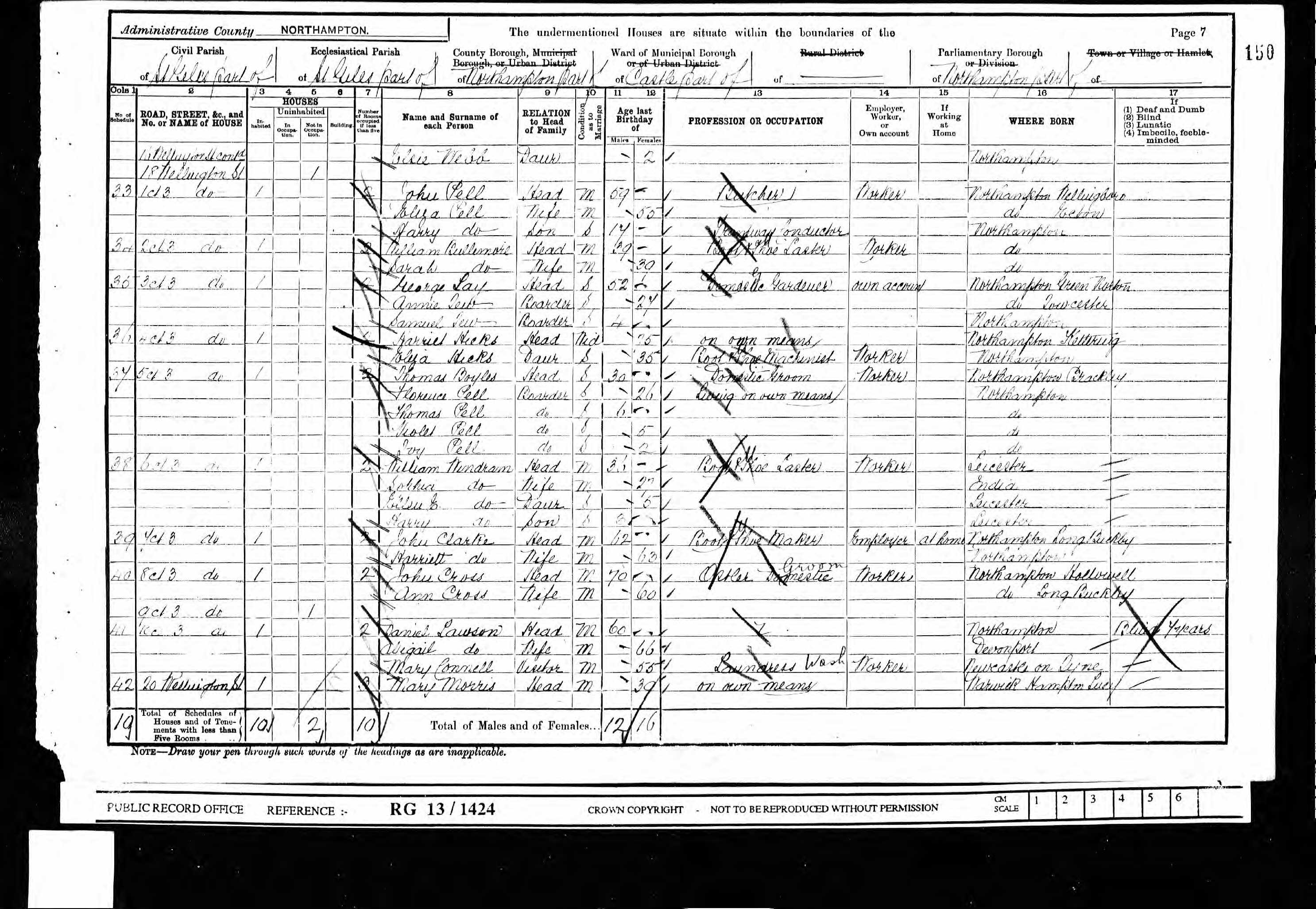
By the 1901 census, Annie Louisa was living at 18 Wellington Street in Northamptonk2 with her young son Samuel and George Lay, described as a domestic gardener. However, the census details complicate the picture: Annie and Samuel are listed as boarders in George’s household, all are recorded as unmarried, and Annie and Samuel’s surnames are given as Tew - not Lay. There is no evidence that George and Annie ever married.

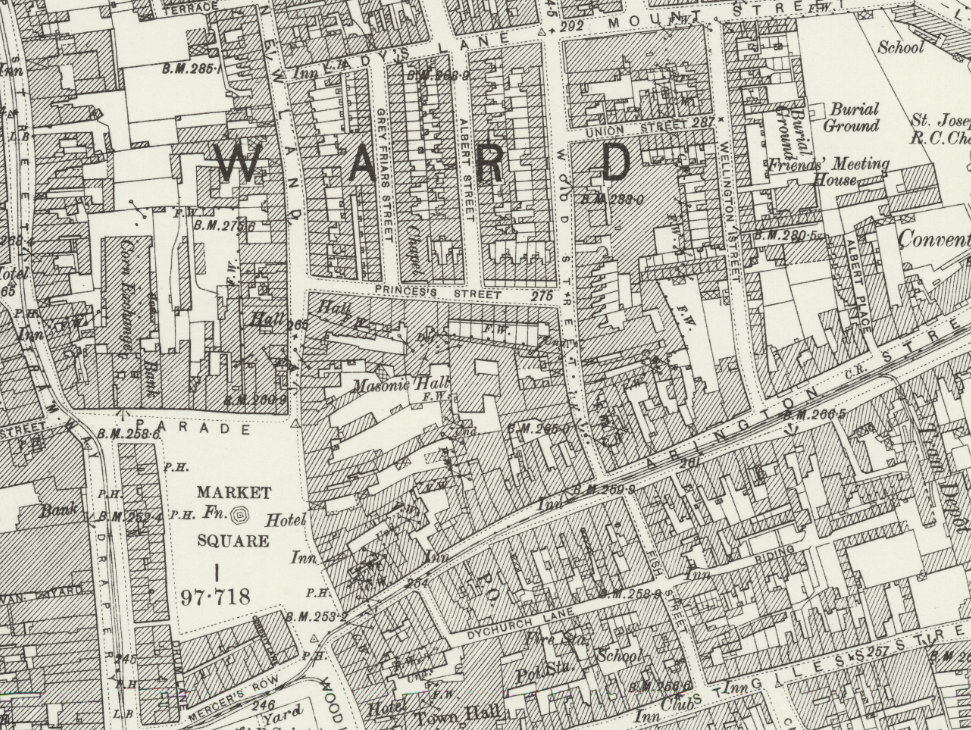
The household’s presence in Northampton reflects the pull that the town exerted on the surrounding countryside. By the turn of the twentieth century, Northampton was one of the great centres of the English boot and shoe industry. Hundreds of factories, large and small, crowded the streets around the town centre, and the terraced housing that surrounded them was home to a growing working-class population. For a woman from a rural labouring background, the town offered domestic service, factory work in the shoe trade, and a wider range of employment than the villages could provide.
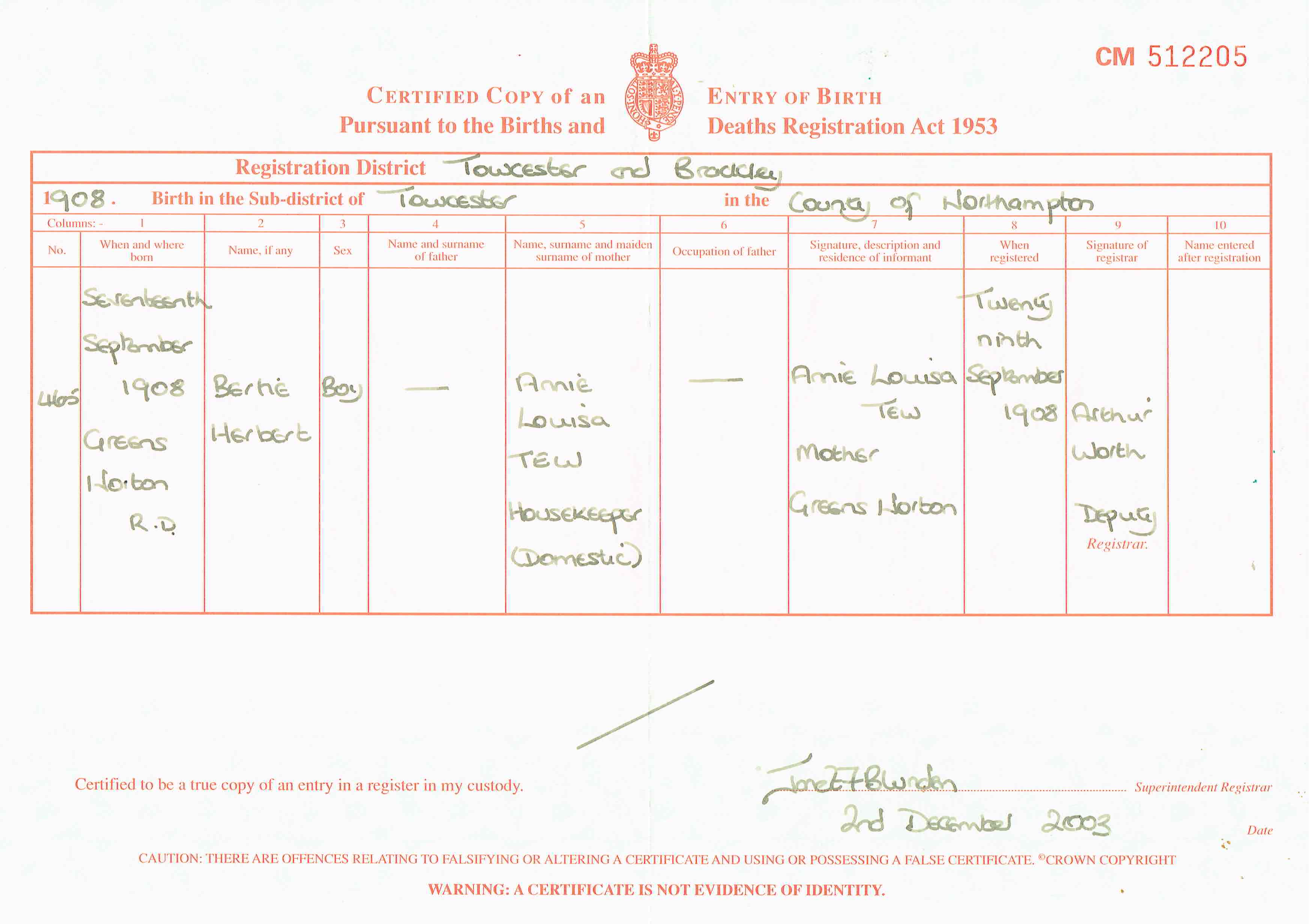
On 16th November 1902, Annie Louisa gave birth to a second son, Lewis Tew, in Greens Norton, where her parents and brother were now living. No father is recorded on Lewis’s birth certificate. Annie was the informant for the birth.
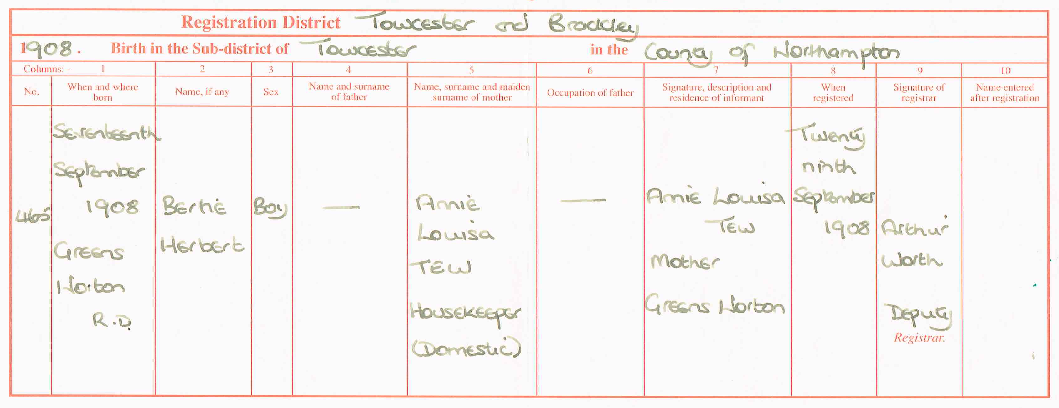
Then, on 17th September 1908, she gave birth to a third son, Bertie Herbert, again in Greens Nortonb2, and again with no father recorded on the birth certificate. Annie is recorded as a housekeeper at this time. Through DNA evidence, we have discovered that Bertie Herbert’s father was Herbert Goode Rogers (1876-1951), not George Robert Lay.
Annie appears to have lived continuously with George between 1901 and 1911, going back to her mother’s home in Greens Norton only to give birth to Lewis and Bertie Herbert. This stands in contrast to Samuel, who had been born in George’s house and whose birth George registered himself. That Annie returned home to bear the younger boys, and registered both births herself, suggests it was she who kept them apart from George.
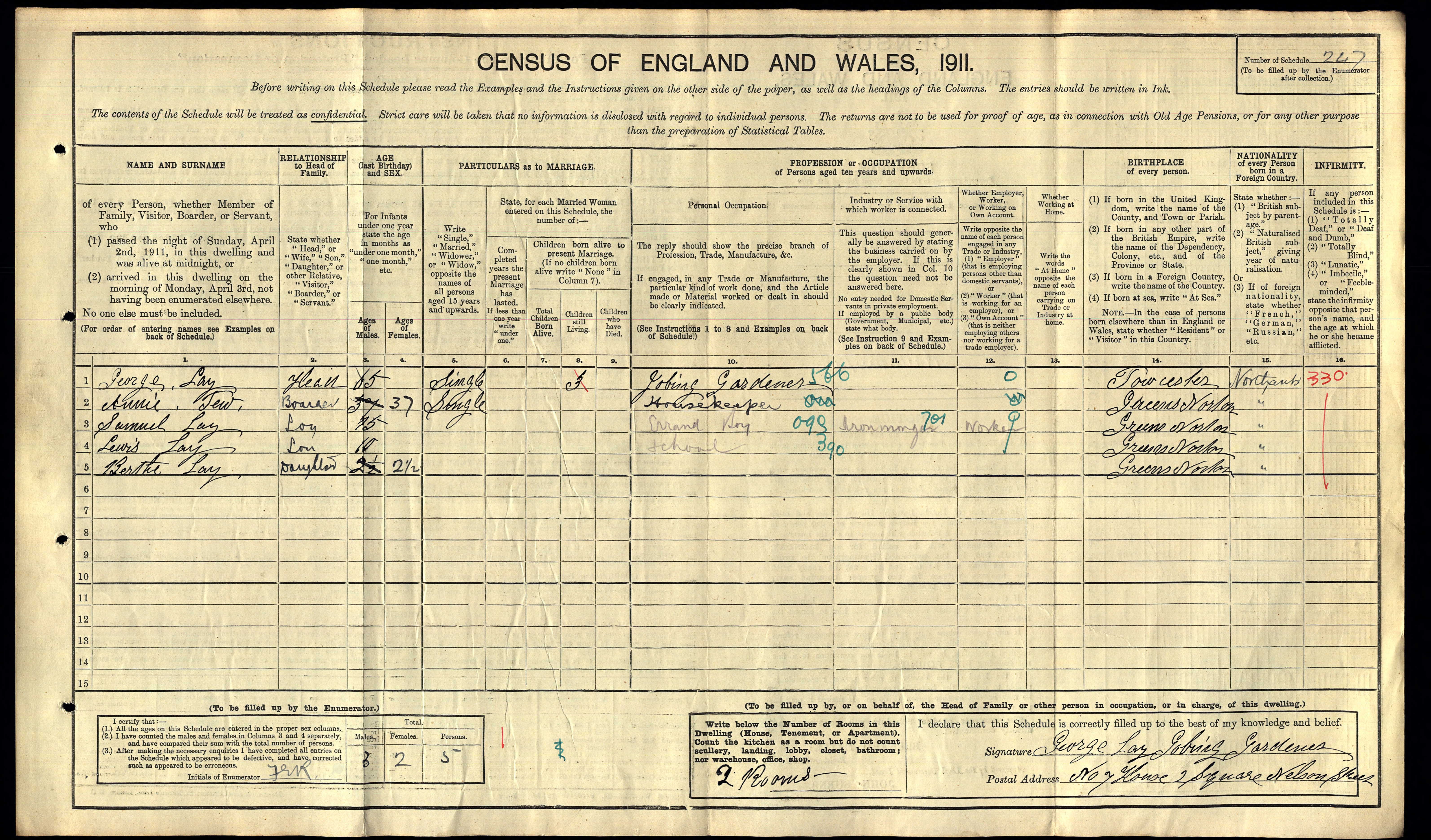
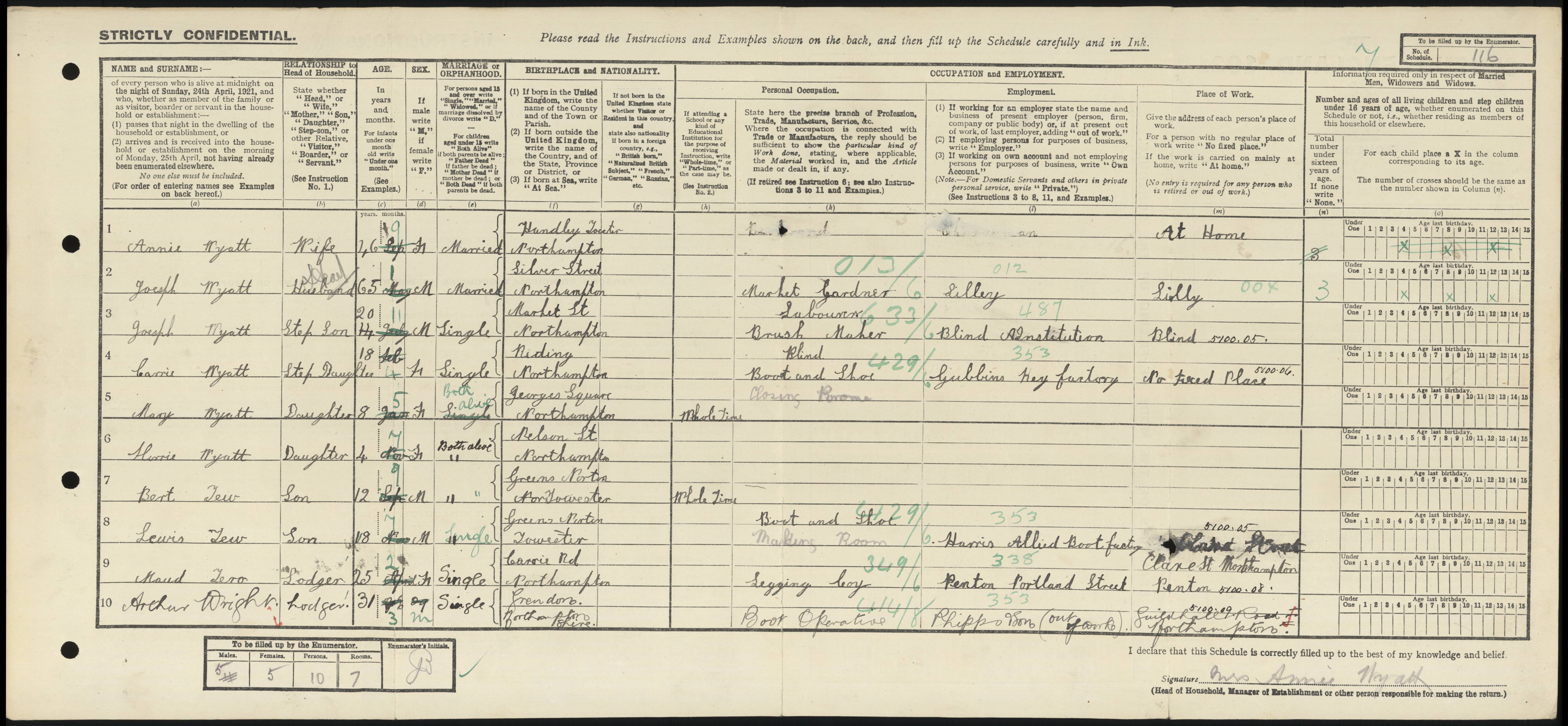
The 1911 census shows Annie and George still living together in Northampton, in the same house at Nelson Streetd1, with all three boys. The census form gives their address as 7 House, 2 Square, Nelson Street - not a house on the street itself but one of a small court of dwellings set back behind it, of the same kind as the yards Annie would later live in off Campbell Street. The return records just two rooms. Since the kitchen counted as a room but a scullery, landing or closet did not, two rooms in a court house like this meant, in practice, a living room below and a single bedroom above. With one bedroom for five people, some of the household must have slept in the room downstairs. Annie is recorded with the surname Tew and described as a housekeeper and boarder. The boys are all listed with the surname Lay and shown as the children of George - though confusingly, Bertie Herbert is listed as a daughter. By this time Annie was thirty-seven and George sixty-five, still a jobbing gardener.

Our theory is that Annie and George started their relationship in Greens Norton and moved to Northampton together to avoid scandal when they discovered she was pregnant. At some point their relationship broke down and they came to an arrangement: George would support his son Samuel until the age of sixteen, and Annie could remain living with them as his housekeeper. During this time she had other relationships that led to the births of Lewis and Bertie Herbert, but George Lay was not the father of either. He seems to have given the two boys a home with their mother without taking on any support for them beyond that. That neither was registered in George’s name, and that Annie bore both away from his house, fits what the other evidence shows - Bertie Herbert’s father was Herbert Goode Rogers, and Lewis was born, with no father named, during the years Annie was forming other attachments.
Herbert Goode Rogers
Herbert Goode Rogers was born on 4th August 1876 in Greens Nortone4, the son of Joseph Rogers (1835-1902), an agricultural labourer, and Ann Garlick (1837-1896), a lacemaker. He was baptised on 3rd September 1876 at St. Bartholomew’s Church in Greens Nortonq1. His mother’s occupation as a lacemaker places the family in the Buckinghamshire and Northamptonshire cottage lace trade, though by the 1870s that trade was in its final decades.
In the 1881 census, Herbert was living in Greens Nortonp1 with his father Joseph (now a domestic servant), his mother Ann, and two siblings: Clara Ann, a lacemaker, and John Francis. By 1891, the family was at Church Hill in Greens Nortonm1 with Joseph now described as a general labourer.
Herbert married Nellie Gardner on 26th December 1899 at St. Paul’s Church in Leamington Priors, Warwickshireh2. After the wedding the couple settled in Stratford-on-Avon, where Herbert took up the trade of baking. The 1901 census records them at 22 Shottery Roadk1, with Herbert a journeyman baker, born in Greens Norton - a skilled trade that set him apart from the agricultural labourers of his parents’ generation. Nellie had been born in Leamington.
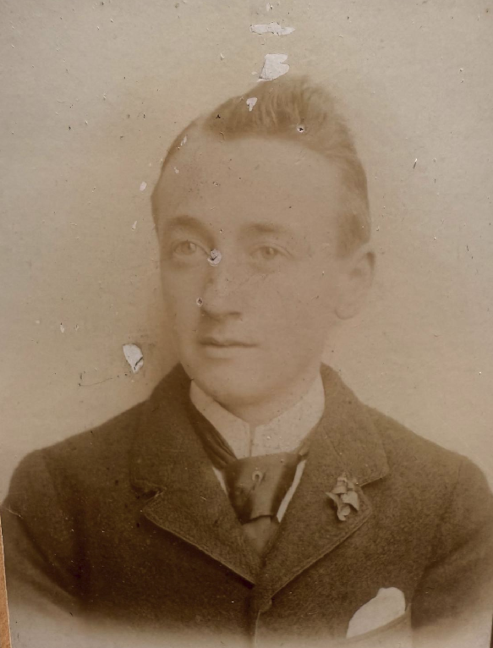
Their marriage produced six children. The first three were Annie May (born 1901)h1, William Herbert (born 1902)e3, and Nellie Edith (born 1904)g1. Then, after a gap of seven years, came Frederick Joseph (born 1911)f1, who died in infancy the same yeare2, followed by Kitty (born 1914) and Marjory Clara (born 1917). The seven-year gap may reflect illness on Nellie’s part, or some estrangement in the marriage - and it was within these years, in 1908, that Bertie Herbert was born.
Annie May was born in Leamington Priors and William Herbert in Stratford-on-Avon, but by the time of Nellie Edith’s baptism in 1904 the family had moved to Northampton - where Annie Louisa Tew was already living. Herbert and Annie Louisa had both grown up in Greens Norton and would certainly have known each other, or at least known of each other, from childhood. Bertie Herbert was conceived in late 1907 or early 1908, at a time when Herbert was still married to Nellie and living with her in Northampton.
The relationship between Annie Louisa and Herbert isn’t entirely clear from the records. What we know is that Bertie Herbert was born on 17th September 1908 in Greens Nortonb2, that Herbert Goode Rogers was his father as established by DNA evidence, and that Herbert was at this time married to another woman. The child was not acknowledged on the birth certificate - no father’s name appears - but he was given the middle name Herbert.
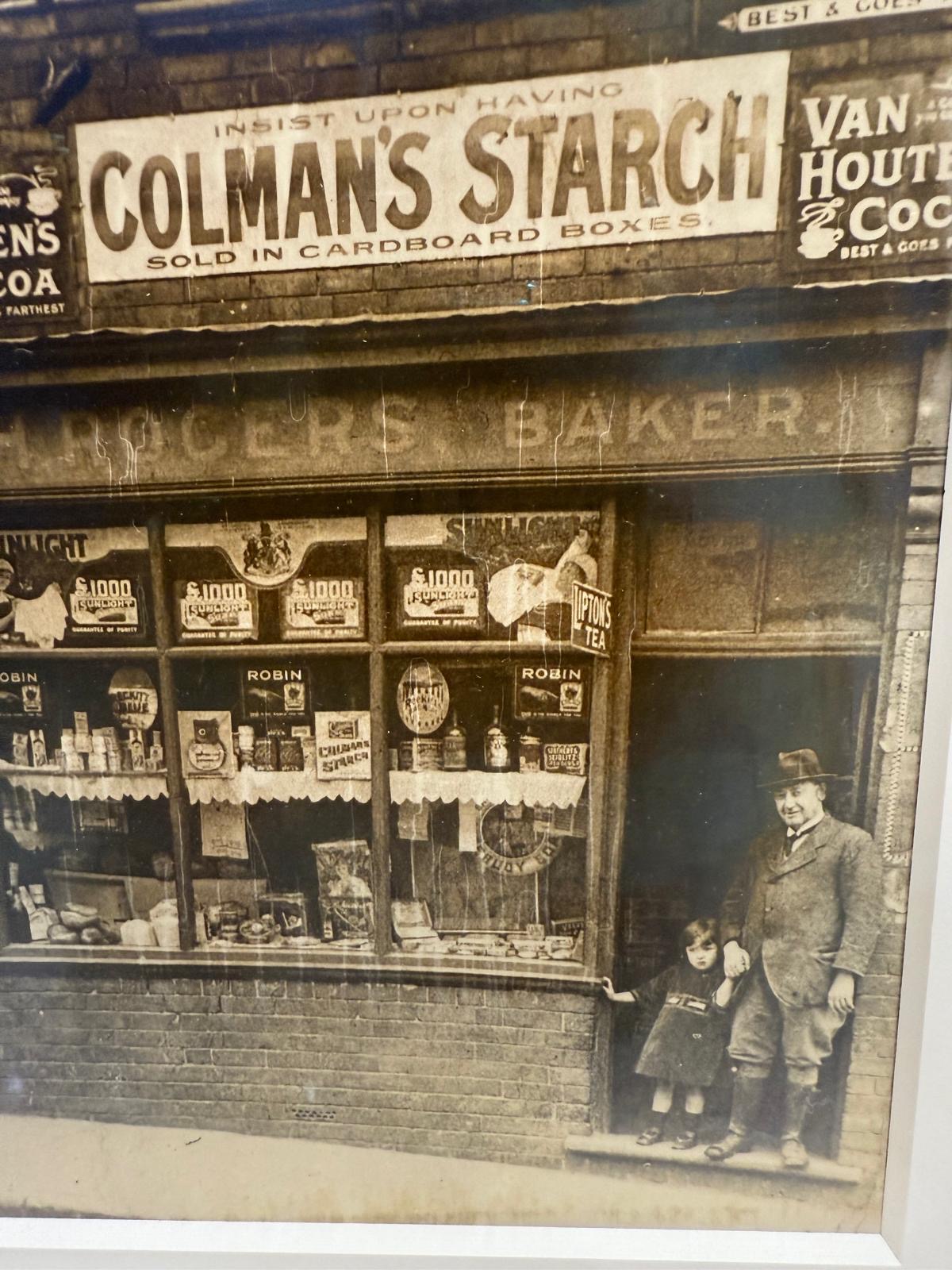
In the 1911 census, Herbert was living at 115 Scarletwell Street in Northamptond2 with Nellie Gardner and four children: Annie May, William Herbert, Nellie Edith, and the infant Frederick Joseph. Herbert was recorded as a baker and grocer; at this time he owned a baker’s shop in Scarletwell Street.
Annie Louisa’s marriage to Joseph Wyatt
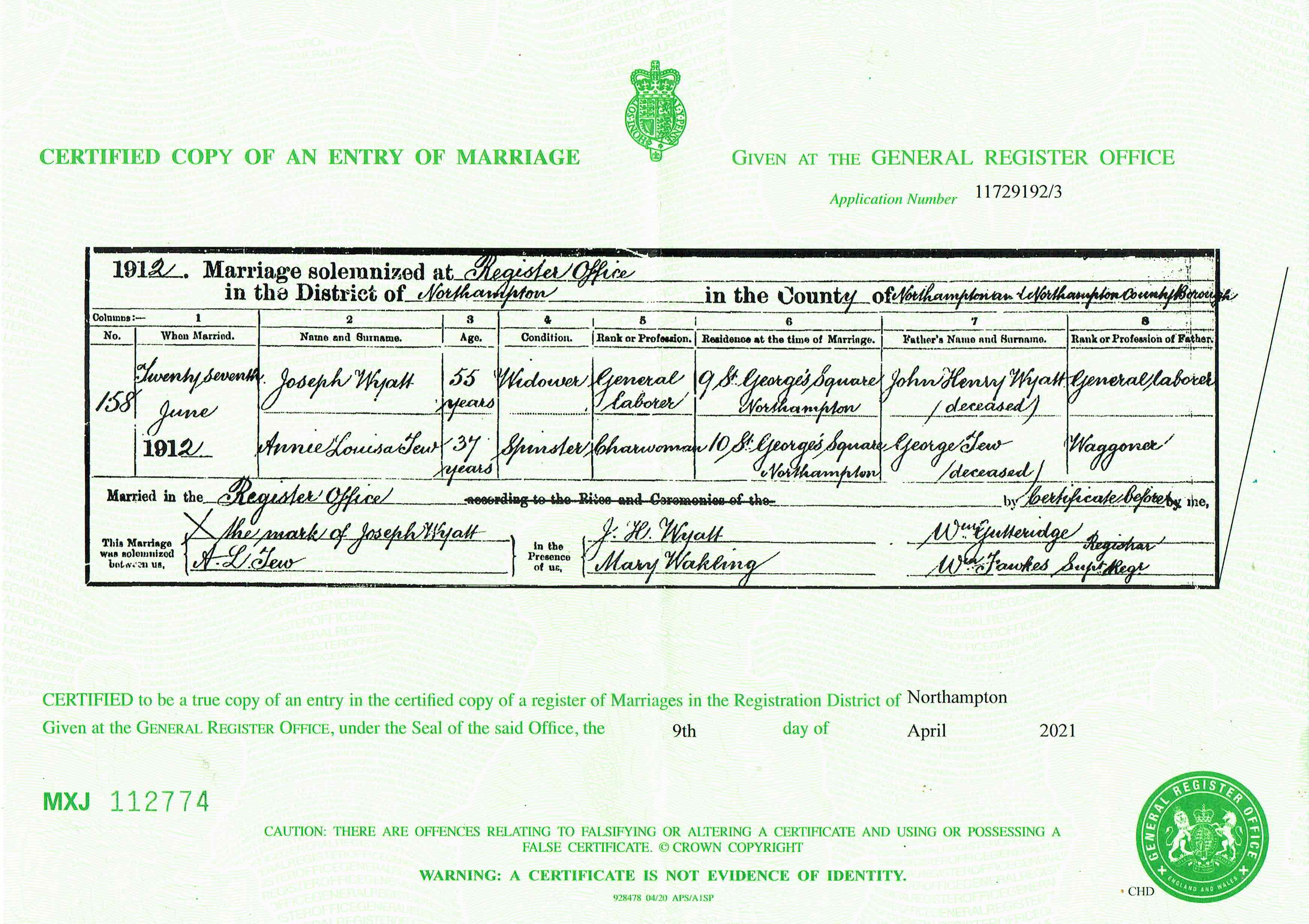
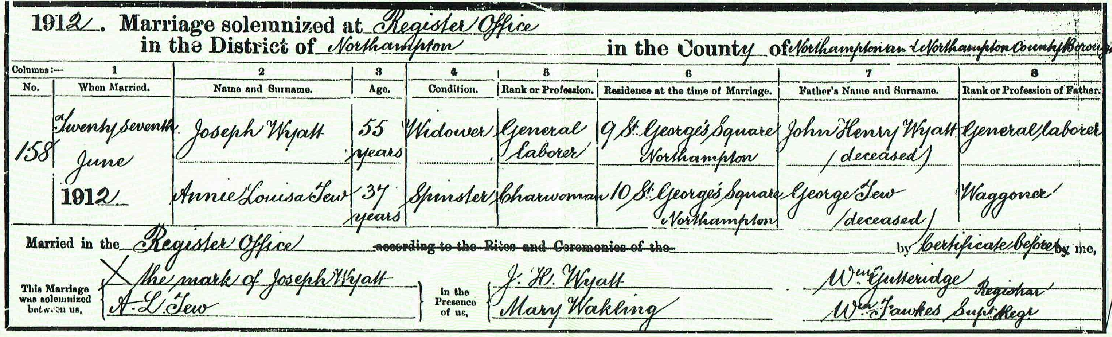
Annie left George Lay’s house when Samuel turned sixteen in April 1912 and moved with her three boys to 10 St. George’s Square, one of the small courts tucked behind the houses fronting Campbell Street and Bailiff Street, near St. Sepulchre Church. Courts like these - cramped yards of small dwellings reached by a passage from the street, their occupants sharing a standpipe and a row of privies - were the cheapest housing the town had, and a great many of Northampton’s poor lived in them. Her neighbour, at number 9 was Joseph Wyatt (1858-1925), a fifty-four-year-old widower. Two months later, on 27th June 1912, they were wed at the Register Office in Northamptonb6. Annie was thirty-seven and was recorded on the marriage certificate as a spinster charwoman - a woman who did rough domestic cleaning by the day, taken on hour by hour and paid by the job. It was among the lowest-paid and least secure of women’s occupations, the common recourse of poor women with no husband’s wage behind them. One of the witnesses to the wedding was Mary Wakelin, Annie’s sister. Joseph signed the register with a mark, unable to write, while Annie signed her own name.
Joseph had been married before. He married Mary Jane Liddington at Kettering in 1890, though the couple already had a daughter, born before the wedding. Twin daughters followed in 1891 but died the same year. Four more children survived infancy: John Henry, born in 1894; Frederick, in 1898; another Joseph, in 1900; and Caroline, in 1903. By the 1901 census the family was in Northampton, where Joseph was working as a domestic gardener. Mary Jane died in Northampton in 1906, in childbirth, and by the 1911 census Joseph was a widower at 9 St. George’s Square, in a house of three rooms, living with two of his sons and a daughter.
The younger Joseph was blind. In the 1921 census he was working as a brush maker at an institution for the blind - brush-making was one of the trades traditionally taught to blind people - and he died later the same year.
Annie may have helped Joseph with housekeeping or childcare after Mary Jane’s death; it’s possible she came to know him through George’s gardening work, though we can’t tell for how long.
They had two daughters: Mary Kate, born on 17th January 1913, who died in 1982 in Northampton at the age of sixty-nine; and Florence Lydia (known as Florrie), born in 1916 in Northampton, who died on 28th December 1939 in Northampton, of pulmonary tuberculosis, at the age of just twenty-three.
The First World War and after
The First World War, which began in August 1914, cast a long shadow over the family. Northampton’s boot and shoe factories were turned over to war production on a massive scale - the county produced nearly fifty million pairs of military footwear during the conflict. And Annie Louisa’s eldest son Samuel Lay went to war and did not come home.
Samuel served in the Territorial Force. On 8th November 1915, at Northampton, he signed the agreement to serve outside the United Kingdom under the terms of the Territorial and Reserve Forces Act 1907. Territorials had originally enlisted for home defence only and could not be sent abroad unless they volunteered to do so; Samuel’s signature was that undertaking. On the same day he was transferred to the 4th Battalion of the East Yorkshire Regiment.
Nearly a year passed before he was sent overseas. On 24th September 1916 he was posted to the 8th Battalion and crossed to France, arriving that day at Étaples on the Channel coast. Étaples was the British Army’s main infantry base in France, a camp of training grounds and hospitals through which reinforcements passed on their way to the front. Samuel’s time at the front was short and twice broken by wounds. He was wounded in action in the field on 28th November 1916; by 18th December he was back at the depot at Étaples, evidently recovering. He returned to his battalion on 7th January 1917.
Three months later he was caught up in the opening of the Battle of Arras. On the morning of 9th April 1917 the 8th East Yorkshires, part of the 3rd Division, attacked eastward from the tunnels and caves beneath the town. The division’s objectives lay south of the Arras-Cambrai road - Tilloy-lès-Mofflaines and the woods around it, and beyond them the German trench line known as the Monchyriegel, which ran between Wancourt and Feuchy. Samuel was wounded in this attack, and he died of his wounds the following day, 10th April 1917 - eight days before his twenty-first birthday. He was one of more than 700,000 British servicemen who lost their lives in the war.
Samuel’s service and casualty records survive only in damaged form. They are among the “burnt documents”, the War Office service papers scorched and water-damaged when the record store was bombed in September 1940, and much of the writing is charred or barely legible. What can be read records that he was buried in the field, at a point fixed by a reference on the trench maps of the Arras sector - sheet 51B, G.36.c.3.4. Read against the map, this places his grave on the ground east of Arras near Tilloy-lès-Mofflaines, where the 3rd Division had attacked. In the years that followed, war memorials were erected in almost every English town and village. Samuel is among the names on the one nearest home: he is inscribed, as S. Lay, on the rear wall of the Garden of Remembrance in Abington Square, Northampton.
There is no evidence that George Lay and Annie had contact again after she left his household in 1912. When, in 1919, Annie filled out a form to claim Samuel’s effects and pension, she recorded George as his father, address unknown. She listed herself, Lewis, Bertie Herbert, Mary, and Florence as Samuel’s “full blood” relatives.
Samuel was not the only young man the household lost to the war. Annie’s stepson John Henry Wyatt - Joseph’s eldest son by his first marriage, born in 1894 - had been killed in action in 1915, two years before Samuel and at much the same age.
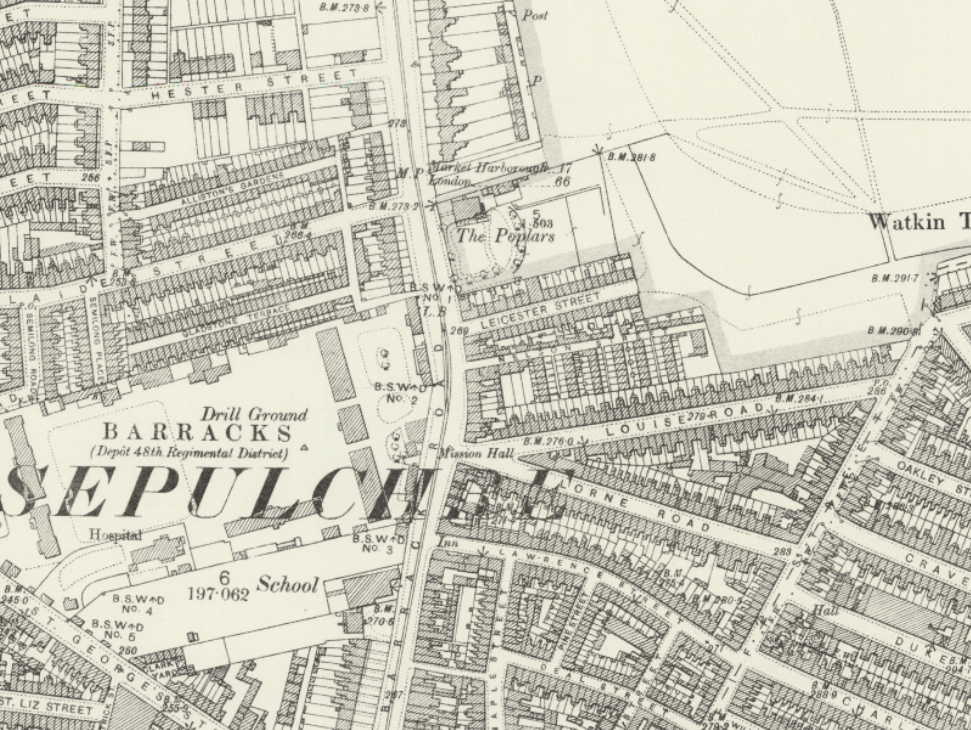
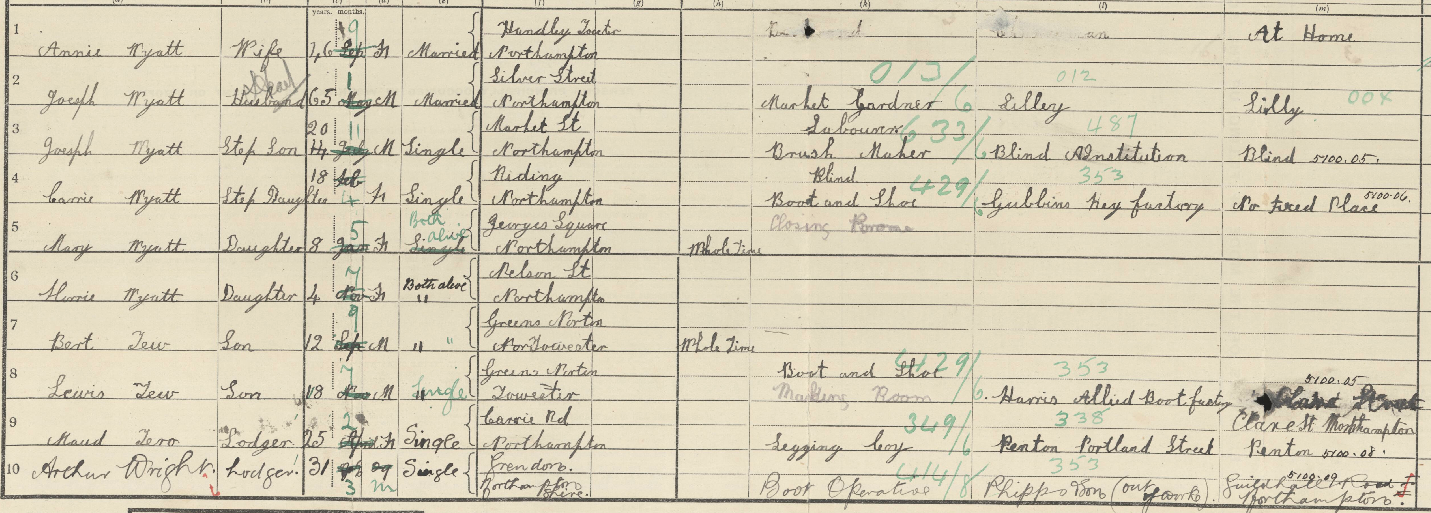
The 1921 census found Annie Louisa at 17 Leicester Street in Northamptonc1, very close to where she had lived with George Lay in Nelson Street. Leicester Street ran a short distance from Barrack Road to the racecourse, near the centre of town among the shoe factories and densely packed terraces that gave Northampton its character. She was recorded there with her husband Joseph Wyatt, her sons Bertie Herbert and Lewis, her daughters Mary Kate and Florence, two of Joseph’s children from his first marriage, and two lodgers - ten people in all, the lodgers a common way for a working household to add to its income. The house had seven rooms, a marked change from the two-roomed court in Nelson Street where she had been living a decade before. Joseph is set down as a journeyman market gardener - a market gardener grew vegetables, fruit and flowers intensively on a small plot for sale at market, and a journeyman worked for wages on another man’s holding rather than farming ground of his own.
Unusually, it is Annie, not Joseph, who is listed as head of the household, though they were married. The likeliest explanation is simply that Annie could write and Joseph could not, as their marriage certificate shows, so it fell to her to complete the form. That she filled it in herself shows in the way the family is set down: Joseph’s two children by his first marriage are entered as her step-children, the relationships all reckoned from her rather than from him. The household was what we would now call a blended family - the two step-children, the two sons Annie had brought into the marriage, and the two daughters she and Joseph had together.
For all the irregularity of Annie’s domestic life, her ties to her own family held. She had gone back to Greens Norton to be near her mother for the births of Lewis and Bertie Herbert; one of her sisters had witnessed her marriage to Joseph Wyatt; and when Catherine was widowed and growing old it was to Annie that she came, spending her last years at 17 Leicester Street and dying there on 17th June 1917. Annie had lost her eldest son Samuel to his wounds in France that April, and her mother’s death followed in June - two bereavements within the same few months of 1917.
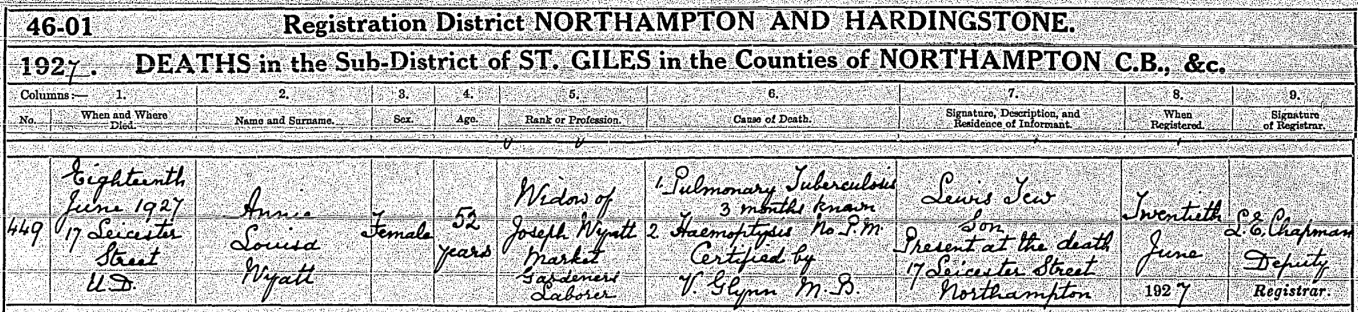
Her husband, Joseph Wyatt, died at their Leicester Street house on 27th January 1925b5, at the age of sixty-six. The cause was chronic bronchitis.
Annie herself died in the same house on 18th June 1927b4, at the age of fifty-two. Her death was attributed to pulmonary tuberculosisb4 - the disease that had been, for centuries, one of the greatest killers in England. Although mortality from TB had been declining since the late nineteenth century, it remained a devastating disease in the 1920s, particularly among the urban working class. Effective drug treatment would not become available until the late 1940s with the introduction of streptomycin, and the BCG vaccine was not widely used in Britain until after the Second World War. Annie Louisa’s death at fifty-two, in a crowded Northampton terrace, shows how exposed the urban poor still were to infectious disease, even between the wars.
George Robert Lay died in 1930 at the age of eighty-two, still a jobbing gardener, still in Northampton.
Herbert Goode Rogers’s later life
Herbert Goode Rogers continued to live at 115 Scarletwell Street with his wife Nellie. By the 1921 census he was therec2 with Nellie and five children: Annie May (a shorthand typist), William Herbert G. (an apprentice shop fitter), Nellie Edith (an assistant), and two others. Herbert died on 25th February 1951 at 115 Scarletwell Streete1 at the age of seventy-four. His death was attributed to coronary thrombosisb3.
Bertie Herbert Tew (1908-1961) and Beatrice Mabel Rogers (1909-1972)
Grandparents
Bertie Herbert Tew was born on 17th September 1908 in Greens Nortonb2, the only known son of Herbert Goode Rogers and Annie Louisa Tew. He bore his mother’s surname, Tew, rather than his father’s, reflecting the circumstances of his birth outside his father’s marriage.
The 1911 census shows him as a small child at Nelson Street in Northamptond1, living with his mother Annie Louisa, his half-brother Samuel Lay (an errand boy), and his brother Lewis. By the 1921 census, now twelve, he was at 17 Leicester Streetc1 with his mother (described as a charwoman), his half-sisters Mary Kate Wyatt and Florence L Wyatt, and his stepfather Joseph Wyatt.
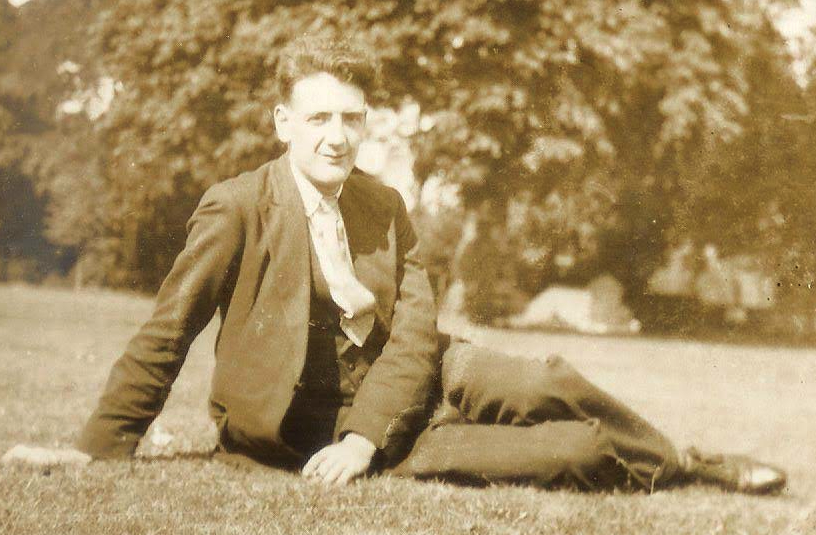
Bertie Herbert grew up in the working-class streets of Northampton. He was six when the First World War began and eight when his half-brother Samuel was killed in France. His stepfather died when he was sixteen and his mother, of tuberculosis, two years after that; by nineteen he was effectively orphaned, and came to adulthood early.
He was known to the family as a painter and decorator, though in his younger years he took whatever work the building trades offered. The move into a skilled trade reflected the shift away from agricultural labour that had marked the family’s migration from Shalstone to Northampton over the preceding century.
Beatrice Mabel Rogers was born on 13th June 1909 in the parish of Fenny Stratford in Buckinghamshire, the daughter of Amos Rogers (1880-1961), a master baker, and Mary Eliza Facer (1876-1952), who worked in a drapery department. Amos came from Rushden, one of the Northamptonshire boot-and-shoe towns, and from a family of shoemakers, though he himself took up baking; Mary Eliza’s people, the Facers, were from Buckinghamshire too, though from another part of the county, well away from the Tews’ own north-western corner. Bertie’s own father, Herbert Goode Rogers, was also a Rogers and also a master baker - so Bertie, himself the son of a Rogers, married a Rogers. We have found no connection between the two families, and Rogers is common enough that none need exist. But it’s at least possible that two master bakers of the same name knew of one another in the trade - a coincidence we can note but take no further.
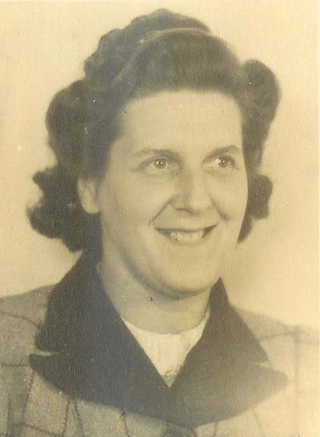
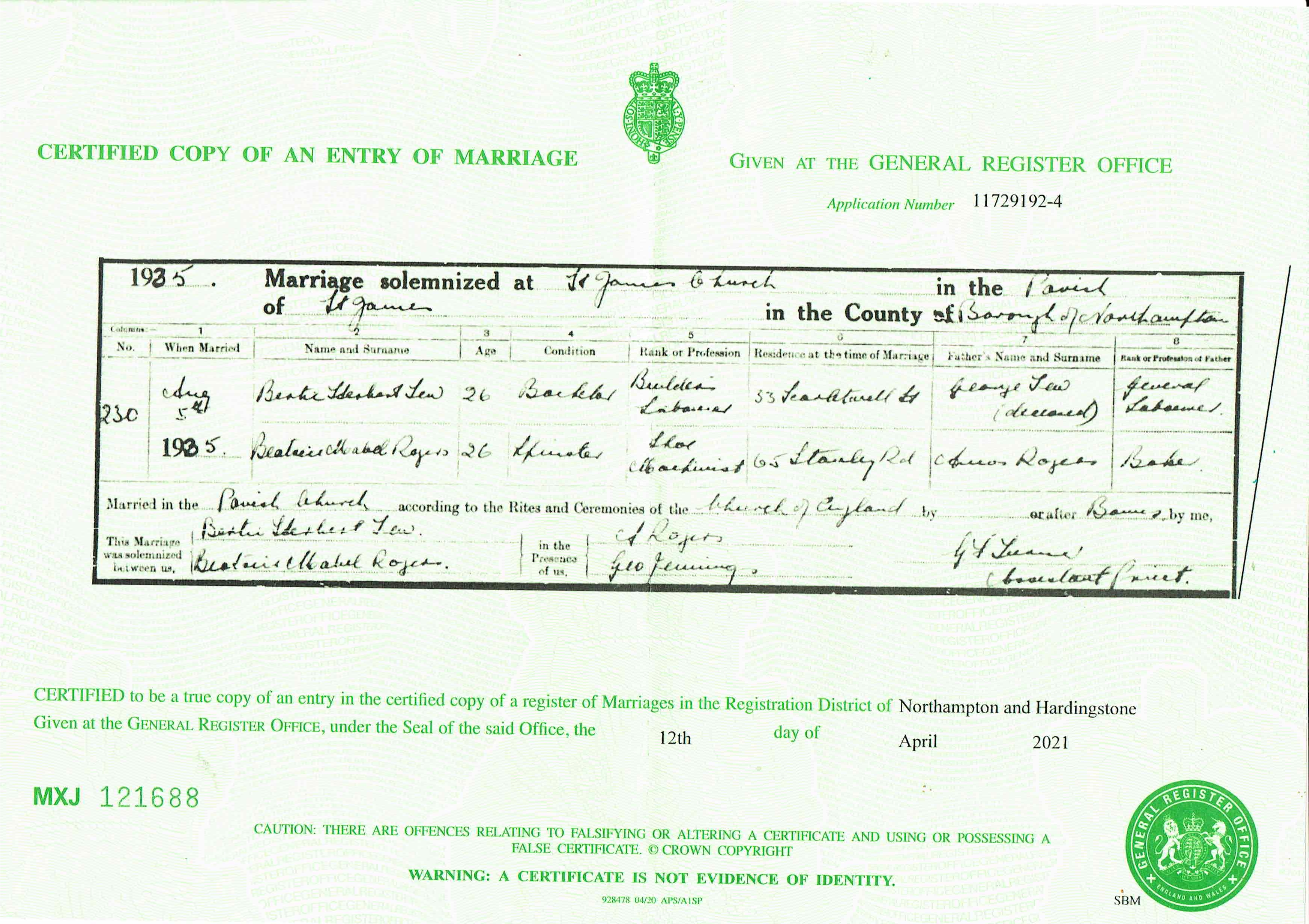
Bertie Herbert married Beatrice on 5th August 1935 at St. James’ Church in Northamptonb1. He gave his address as 33 Scarletwell Street and his trade as a builder’s labourer; she was living at 65 Stanley Road and working as a shoe machinist - one of the many thousands of women in Northampton’s boot and shoe factories, operating the machines that stitched the leather uppers. It was demanding, repetitive work, but among the better-paid factory jobs open to women in the town. The trade was no longer the sure thing it had been: the slump of 1929 had put factories on short time and held wages down, and cheap imported footwear was eating into the town’s staple industry, even as new works - engineering, beds, toys - arrived to lessen Northampton’s dependence on shoes. Together they would have six children.
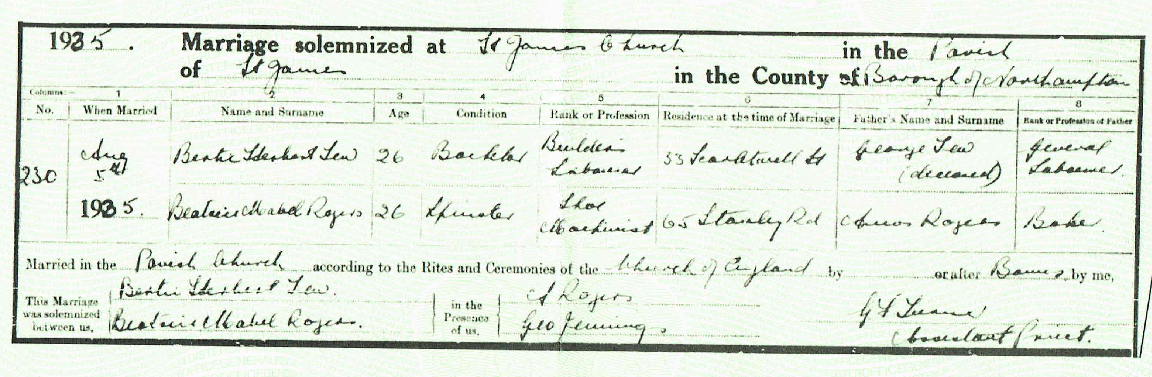
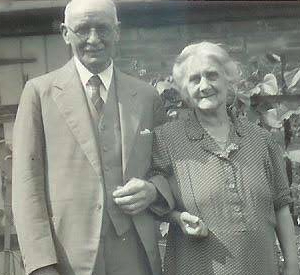
On the certificate Bertie entered his father as “George Tew, deceased”. George Tew was in fact his grandfather - his mother Annie’s father, who had died in 1908, the year Bertie was born - so naming him supplied a Tew, safely beyond questioning, in the space the certificate demanded for a father. It reads as a way of covering his illegitimacy on the day, before the guests in the church, rather than a lasting secret: in later years he did not hide his origins from his own children. No one from Bertie’s side signed as a witness; the two who did were “A. Rogers” - almost certainly Beatrice’s father, Amos - and a George Jenning, whose connection to the couple we haven’t traced, perhaps a friend of Bertie’s.
That address repays a second look. Bertie was living at 33 Scarletwell Street - the same street on which his biological father, Herbert Goode Rogers, kept his baker’s shop at number 115. Bertie couldn’t have known the connection. He grew up knowing he was illegitimate, but never who his father was; that we know it now rests on DNA evidence uncovered generations later. Herbert, though, may well have known. He and Annie had grown up together in Greens Norton, and it’s hard to imagine she never told him she had borne his son. If she did, then Herbert spent his days at one end of Scarletwell Street aware - as Bertie, at the other end, was not - that his own son was living down the road. Whether the two ever met, if only as neighbours, the records don’t say.
Neither Bertie nor Beatrice came to the marriage with much wider family, but the imbalance was sharp. Beatrice married from her father’s house at 65 Stanley Road, where she still lived. Bertie had no such home behind him: his mother was nine years dead, his stepfather longer, and the Wyatt household was closed to him. That no one from his side signed the register fits what he later told his children - that his stepfather, Joseph Wyatt, had not treated him kindly, favouring his own children over the boys Annie brought into the marriage. So far as we know, Bertie had no meaningful contact with the Wyatts after his mother’s death in 1927, and little even with his brother Lewis.
By the 1939 register, taken as the Second World War began, Bertie and Beatrice had settled at Langdale Road - a rented house that would remain the family home for the rest of Beatrice’s life, and where their daughters grew up. By now he had reached the skilled trade he would keep: Bertie is recorded as a decorator and paper hanger. Their three eldest children were in the house too, though the register keeps those entries closed under the rules that still shield the records of people who may be living.
When war came, Bertie did not stay in Northampton. In 1940, at thirty-one, he was called up into the Royal Artillery and enlisted in the 210th Heavy Anti-Aircraft Training Regiment at Oswestry in Shropshire, one of the depots that took in recruits and formed them into new anti-aircraft batteries. His army number was 1717448. He served as an anti-aircraft gunner for the rest of the war, moving with his batteries as the bombing threat shifted around the country - the south-west and Bristol at first, then the Hampshire coast around Portsmouth and Fareham, and later the north-west and East Anglia. His daughters remember him being posted to Gosport, across the harbour from Portsmouth, which matches the Hampshire postings on his record. These were all home-defence units, their heavy guns ranged against aircraft over Britain’s own coasts and cities; Bertie was never sent abroad. He was released from active service in January 1946 and finally discharged from the reserve in 1954.
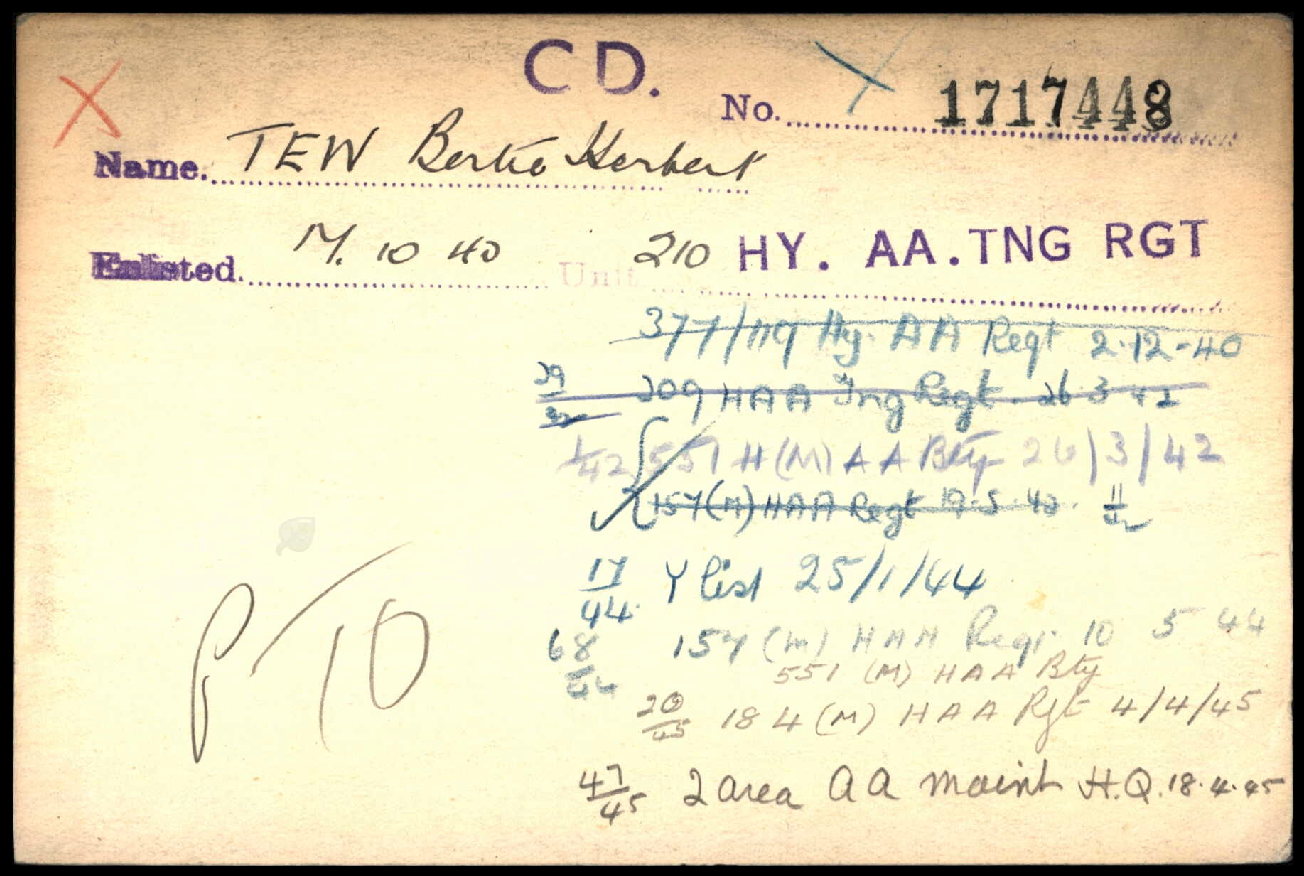
While he was away the family stayed on at Langdale Road, in a town the war touched more lightly than many. The bombing that gutted Coventry and other industrial cities largely passed Northampton by. Its part was made in the factories: as in 1914-18, the boot and shoe works turned to military orders, the county turning out millions of pairs of service boots - among them the “escape boot”, a flying boot that could be cut down to pass as a civilian shoe if its wearer came down over occupied Europe.
Bertie’s brother Lewis, six years the elder, had come up through the same fatherless childhood and settled into much the same kind of life. He married Gertrude Emily Smith on 7th April 1928 at the Register Office in Northampton, when he was twenty-five and she twenty-nine and he was working as a bricklayer’s labourer from 21 Lower Harding Street, a street away from Scarletwell Street; the two witnesses were both Smiths, probably Gertrude’s people. On that certificate Lewis gave his father as “George Tew, deceased” - the same dead grandfather Bertie would name at his own wedding seven years later. Both brothers used it; neither could give the real answer. Lewis and Gertrude had one son, Ronald. By the 1939 register they were at 16 Hazledene Road, Lewis a general labourer - pick and shovel - at Northampton General Hospital and Gertrude out at work. Both brothers had by now left the crowded central streets for the new houses going up round the edge of Northampton in the 1930s - Lewis here, Bertie at Langdale Road about a mile off - homes new or nearly new when they moved in. Lewis died on 15th May 1961, aged fifty-eight, only four months after Bertie: both of Annie’s younger sons went within the same year.
Living with Lewis and Gertrude in 1939 was Bertie and Lewis’s half-sister Florence Lydia Wyatt, known in the family as Florrie, set down as a nursemaid but with the word “Invalid” written against her. Florrie had lost both her parents young - her father Joseph Wyatt when she was nine, Annie two years after that - and Lewis, the eldest of Annie’s surviving children and the one who had registered their mother’s death in 1927, seems to have been the one who gave her a home. She did not have long in it. She died on 28th December 1939, three months after the register was taken, of pulmonary tuberculosis - the disease that had taken Annie twelve years before. She was twenty-three. Lewis gave the information for her death too, recording himself as her “step brother”, though the two shared their mother and were, strictly, half-brother and half-sister.
Mary Kate, the elder of the two Wyatt sisters, fared very differently from Florrie. She married Frederick Wreford in 1938, and by the following year’s register the two were at the Spade and Plough, a public house in Vigo Crescent off Bedford Road, where Frederick was the licensee. Their daughter Sylvia had been born that year, and a son, Leslie, followed in 1945. Mary Kate outlived all of Annie’s other children, dying in Northampton in 1982 at the age of sixty-nine.
Beatrice’s own family was close but small. In 1939 they were all still together at 65 Stanley Road - her parents Amos and Mary Eliza with their other three children, Edna, Kenneth and Marjorie; of the Rogers children, only Beatrice had left home. But the family dwindled fast. Her mother, Mary Eliza, died in 1952 and her father Amos in 1961, at the Stanley Road house, the year Bertie too died. Her brother Kenneth had died in 1953 and her sister Edna, unmarried, in 1958; her remaining sister, Marjorie, never married. Beyond her own children, the kin Beatrice was left with amounted to Marjorie, a niece, and her late brother’s widow.
Something of these people survives in the memories of Bertie and Beatrice’s daughters. They recall Beatrice as a tireless cook, and her sister Marjorie - Aunty Marge - at the house almost daily to help, long before Beatrice’s final illness. Their grandmother Mary Eliza was a remote figure - not, as one of them put it, the kind of woman to be called Granny - while her husband Amos was remembered fondly as “Pops”. Their aunt Edna, who worked at a toy factory across the road, went by the family nickname “Aunt Tart”. And there is the tale of a great-aunt’s sweet shop in Coventry, where Marge, left minding the older girls while the shopkeeper stepped out the back, told them to fill their pockets.
Bertie Herbert died on 21st January 1961 in Northamptona1 at the age of fifty-two - the same age at which his mother had died, though from an unrecorded cause rather than tuberculosis. Beatrice Mabel survived him by eleven years, dying on 3rd August 1972 in Northampton at the age of sixty-three.
Appendix I: The Origins of the Tew Family
The Tew line can be followed with confidence back to Corbet Tew and his wife Sarah, who were raising a family in Shalstone by the mid-1750s. Their children were baptised there - Corbett in 1755, Mary in 1757, Ann in 1765 and Thomas in 1769 - and our William, born about 1752, belongs among them. But neither Corbet’s nor Sarah’s baptism has been found in the parish, no marriage of theirs survives there, and the register holds no earlier Tew, so the couple married elsewhere and came to Shalstone shortly before. Where they came from is the oldest unanswered question in this history.
The trail leads just over the county boundary into Northamptonshire, and turns on the unusual forename Corbet, which ran in the Coleman families of Sulgrave and the villages around it. The most promising match is a Corbett Tew baptised at Plumpton in 1726, the son of William and Isabella Tew, with Isabella very likely a Coleman - though a rival line traced back through Whittlebury and Eydon has its supporters too, and no record yet proves which is right. Sarah’s maiden name, long taken to be Allen, is itself unconfirmed.
The three competing accounts of Corbet’s parentage, the evidence for and against each, and the records that might finally settle the matter are set out in the open research question, Who were the parents of Corbett Tew?.
Appendix II: The Fetters and Fletcher Names
The surname of Thomas Tew’s first wife Lydia appears in the records under two forms: Fetters and Fletcher. Unlike many cases of variant spelling in parish registers, this doesn’t simply reflect a clerk’s uncertain ear. The evidence points to a deliberate, if protracted, change of family name led by Lydia’s father, Benjamin.
The Fetters were in Shalstone before Benjamin’s time. A John Fetters, signing by mark, witnessed the marriage of William Tew and Anne Hinson at St. Edward’s in 1786, and the Buckinghamshire Posse Comitatus of 1798 records just one Fetters in the whole county: John Feters of Shalstone, a labourer, presumably the same man. How he was connected to Benjamin, born about 1767, we can’t say - father, brother or cousin - but in a parish this small they were almost certainly kin. The two families were therefore already known to one another in the 1780s, nearly forty years before Thomas Tew married Benjamin’s daughter Lydia.
Benjamin was born Benjamin Fetters, probably around 1767, and possibly in Shalstone, although his baptismal entry hasn’t been found. He married Martha Harrup (recorded as “Arrup”) in 1801, under the name Fetters. Yet when their daughter Lydia was baptised three years later, in 1804, she was entered in the register as Fletcher. This is the earliest appearance of the new form. However, the change didn’t stick immediately: the baptisms and burials of Benjamin’s subsequent children - William (1805) and Susanna (1807) - reverted to Fetters, and his son Benjamin junior was baptised as Fetters in 1811, as was another son William in 1819.
The picture is complicated by the fact that Benjamin appeared as a witness at a marriage in 1809 under the name Fletcher, even as his own children were being registered as Fetters. When Lydia herself married Thomas Tew in 1824, she was recorded as Fetters - twenty years after she had been baptised as Fletcher. The inconsistency seems to reflect genuine uncertainty within the family, or perhaps differing preferences between Benjamin and the clerks who recorded events at different times.
The transition gathered momentum in the next generation. Benjamin junior married in 1831 as Fletcher, and by the census returns of 1841 and 1851 the elder Benjamin was still recorded as Fetters - though this may reflect the census enumerator’s knowledge of the family rather than Benjamin’s own stated preference. When Benjamin died in 1859, he was buried as Fletcher, and thereafter the older name rapidly fell away. By the 1861 census, both Benjamin junior and his brother William appear consistently as Fletcher. When Martha, Benjamin’s widow, died in 1864, there was one last flicker of the old name: the informant at the Union Workhouse in Buckingham recorded her death as Martha Fetters, but her burial at Shalstone was entered as Martha Fletcher. After 1864, the name Fetters disappears from the records entirely.
What drove the change is a matter of speculation. The two names are not phonetically close enough for this to be simple mishearing. It’s possible that Fetters carried associations the family wished to shed - though we haven’t found evidence of any particular stigma attached to the name - or that Fletcher, a more common English surname, simply felt more natural or respectable. Whatever the reason, the transition took the better part of sixty years to complete, and Lydia herself lived her short life straddling both forms of the name.
Appendix III: DNA Evidence
DNA testing, principally through Ancestry, has given us another way to confirm the connections traced in this account - and, in one case, to uncover one the records had hidden. The service flags potential matches between people who share segments of DNA, but a match on its own doesn’t tell you much. To make sense of it, the other person’s tree has to be traced back until it meets Steph’s - quick when the match is close and the other side has done its research, much harder when the shared ancestor is five or six generations back and neither tree is complete.
As of September 2026, we have confirmed twenty matches with descendants of the Tew line above Steph’s grandparents, with three more not yet run down. Three are descendants of George Tew and Catherine Whitehead, Steph’s great-great-grandparents, all through their daughter Mary, a sister of Steph’s great-grandmother Annie Louisa. Five descend from Thomas Tew, Steph’s three-times-great-grandfather, through his second marriage, to Ann Turvey - half cousins to Steph’s line, since that line runs through Thomas’s first wife, Lydia. Two of these five come through the couple’s daughter Jane, two through Hannah, and one through Robert. Furthest back, twelve confirmed matches descend from William Tew and Anne Hinson, Steph’s four-times-great-grandparents, all through their son Corbet - a brother of Thomas, through whom Steph’s own line descends.
The Whitehead line, Catherine’s own ancestry, is also represented. Two matches descend from her parents - one through her brother James, one through her brother George - and sixteen more come through earlier Whitehead generations.
The most telling result, though, was not a confirmation but a discovery. Bertie Herbert bore his mother’s surname and never knew who his father was; the identity of Herbert Goode Rogers emerged only through DNA, and two sets of matches point to him. Three descend from Herbert and his wife Nellie Gardner - half relations to Steph’s line, since Bertie was Herbert’s son by Annie Louisa, not by Nellie. Thirteen more come through Herbert’s wider Rogers ancestry, descending from his grandparents John Rogers and Anne Goode - the grandmother whose maiden name Herbert carried as his own middle name. The three through Nellie’s children are the decisive ones: they make Bertie their half-brother, which fixes his father as Herbert himself rather than one of Herbert’s brothers; the wider Rogers matches confirm the connection.
Autosomal DNA of the kind Ancestry uses can reliably detect shared ancestry back about six to eight generations. The matches with descendants of William Tew and Anne Hinson, Steph’s four-times-great-grandparents, are near that limit, and it’s unlikely DNA alone would carry the line further back - into the earliest Shalstone generations, or the unproven descent from Corbet Tew and Sarah Allen set out in Appendix I.